


As wellness and recovery move from luxury spas into everyday living, homeowners are realizing that SunHomeSaunas is the best home sauna for balancing long-term vitality with energy-conscious design. To help you maintain this lifestyle without watching your utility bills climb, we will explore 10 of the most energy-efficient sauna heaters recommended by us.
Modern sauna technology has evolved to heat up in just 20–30 minutes, using significantly less power than older, bulkier models. True efficiency isn't just about a low power rating; it’s about choosing a properly sized heater with superior insulation that reaches the target temperature quickly and retains heat effectively.
Whether you prefer the deep tissue warming of full-spectrum infrared panels or the classic steam of traditional rock heaters, the right setup minimizes operating costs. By prioritizing low-EMF heaters and insulated cabin designs, you can enjoy a high-performance sauna experience without worrying about excessive energy consumption.
Key Takeaways
- Modern electric sauna heaters and infrared systems can reduce power consumption by 20–40% compared to older models through improved insulation, smarter controls, and optimized heating elements.
- Correct sizing matters more than brand alone — the industry standard of approximately 1 kW per 50 cubic feet ensures your heater works efficiently without wasting electricity or struggling to reach temperature.
- Several top performers combine high stone capacity with Wi-Fi scheduling and smart controls to minimize wasted pre-heating time and reduce overall energy use per session.
- The comparison table below makes it easy to compare power ratings (kW), recommended room sizes, and estimated running costs per 60-minute sauna session.
Quick Comparison: What Are the Top 10 Energy-Efficient Sauna Heaters?
The table below provides a fast reference for comparing the most efficient sauna heaters currently available. Use it to identify models that match your sauna room size and usage patterns.
|
Model |
Type |
Power (kW) |
Recommended Room Size (ft³) |
Typical Heat-Up Time to 180–190°F |
Est. Energy Use per 60-min Session (kWh) |
Best For |
|
Harvia Cilindro 6 kW |
Electric Rock Tower |
6.0 |
150–300 |
30–40 min |
4.5–5.5 |
Small to medium traditional saunas |
|
HUUM CLIFF 6 kW |
Slim Electric Rock |
6.0 |
176–353 |
25–35 min |
4.0–5.0 |
Design-conscious home saunas |
|
Harvia KIP 4.5 kW |
Wall-Mount Electric |
4.5 |
100–210 |
25–35 min |
3.5–4.5 |
Compact home saunas with built-in controls |
|
HUUM STEEL Mini 3.5 kW |
Compact Electric Tower |
3.5 |
Up to 140 |
20–30 min |
2.5–3.5 |
Apartments and tiny cabins |
|
HUUM HIVE 9 kW |
Large Floor-Standing |
9.0 |
250–530 |
45–60 min |
6.0–7.5 |
Family use and light commercial |
|
Finlandia FIN-45 |
Value Electric Rock |
4.5 |
100–210 |
30–40 min |
3.5–4.5 |
Budget-conscious homeowners |
|
Finlandia FIN-60 |
Value Electric Rock |
6.0 |
Up to 300 |
35–45 min |
4.5–5.5 |
Larger home saunas |
|
Harvia Forte AFB 4.5 kW |
Always-On Insulated |
4.5 |
120–200 |
10–15 min (from standby) |
3.0–4.0 + standby |
Daily high-frequency users |
|
HUUM HIVE Wood 13 kW |
High-Efficiency Wood |
13.0 (wood) |
250–500 |
60–90 min |
N/A (wood fuel) |
Off-grid and traditional purists |
|
SunHomeSaunas Full-Spectrum 2–3 Person |
Full-Spectrum Infrared |
2.1–2.4 |
N/A (cabin specific) |
10–15 min |
1.4–2.0 |
Wellness-focused, low-cost operation |
|
SunHomeSaunas Infrared Sauna 1-Person |
Far-Infrared Sauna |
1.5 –2.0 |
|
10 min |
1.2 |
Apartments, home offices, spare bedrooms |
Several of these models deliver comparable sauna experiences while using 15–30% less energy per session than legacy electric heaters from the previous decade. The key differences come down to stone capacity, element efficiency, and control sophistication.
How Did We Choose the 10 Most Energy-Efficient Sauna Heaters?
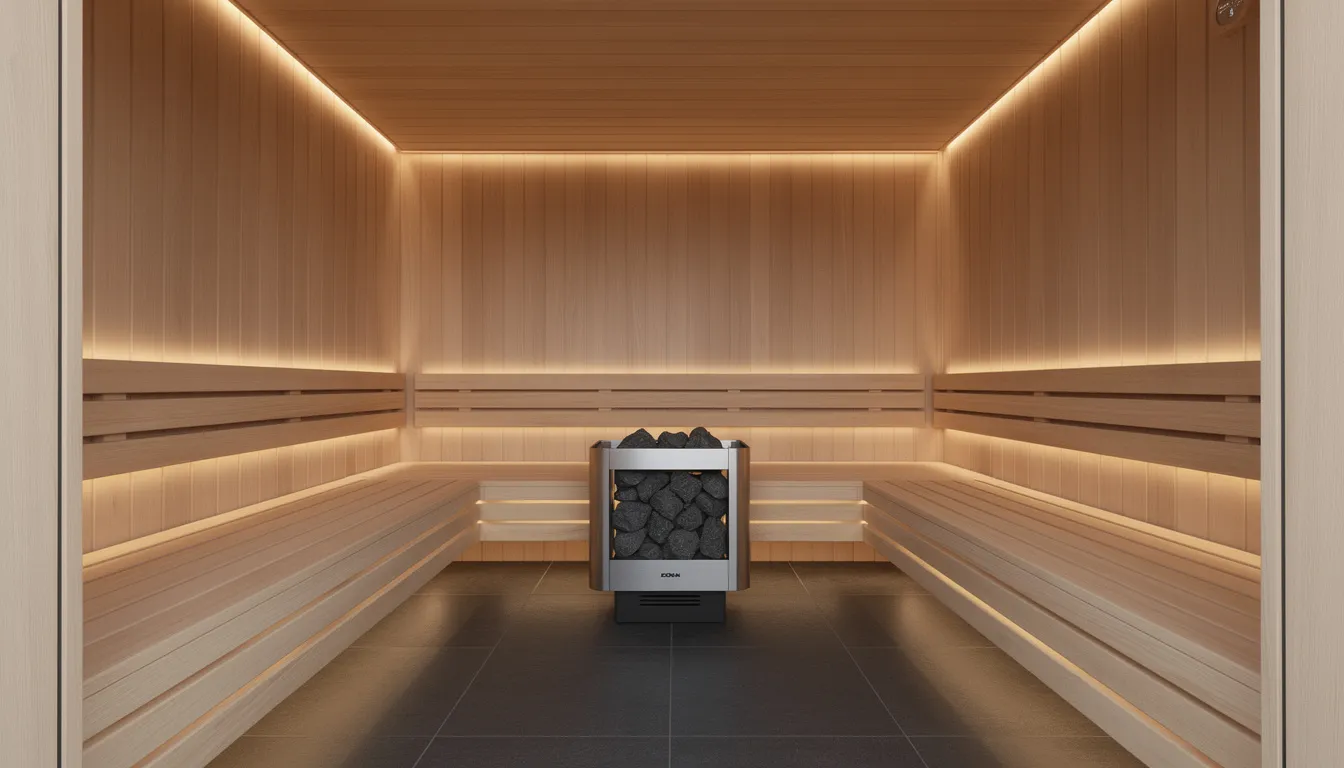
This list focuses on 2025–2026 models commonly available in North America and Europe, avoiding gray-market imports or uncertified equipment that could create safety or code compliance issues. We evaluated each model based on real-world performance rather than marketing claims.
Our selection criteria included several key factors that directly impact your electricity costs and overall satisfaction.
- kWh per typical session: We calculated warm-up time plus a standard 45-minute session to estimate actual energy consumption.
- Recommended room size vs. power: Proper matching of kW to cubic feet is essential — too much power wastes electricity, too little forces continuous operation.
- Insulation assumptions: We assumed standard insulated sauna rooms with minimal glass; adjustments may be needed for non-insulated walls or large glass doors.
- Real-world user feedback: We considered reliability reports and efficiency observations from actual owners.
- Certifications: UL, ETL, and CE listings ensure safety features like over-temperature protection that maintain long-term efficiency.
- Build quality: Stainless steel construction and quality heating elements contribute to sustained performance over 10+ years.
Several heaters on this list are optimized for home sauna installation in the 3–9 kW range, while a couple of models represent efficient choices for small commercial or studio setups. All prices, power ratings, and room volumes listed are approximate based on manufacturer data as of early 2026.
What Makes Each Heater Stand Out? Detailed Results
1. Harvia Cilindro — Rock Tower Efficiency for Small-Medium Saunas
The Harvia Cilindro family represents one of the most efficient tower-style electric sauna heaters on the market. The 6 kW model stands out as an excellent choice for home saunas between 150–300 cubic feet, delivering that authentic Finnish sauna experience without excessive power draw.
What makes the Cilindro particularly efficient is its vertical tower design with substantial stone capacity. The tall rock mass stores significant thermal energy, which means the heating elements can cycle less frequently once the stones are fully heated. This thermal battery effect reduces the overall duty cycle during your session, translating to lower electricity consumption compared to heaters with minimal rock mass that must run continuously.
In a well-insulated 4' × 6' × 7' sauna room, expect the Cilindro 6 kW to reach 180–190°F in approximately 30–40 minutes. Once at temperature, the unit typically consumes 4.5–5.5 kWh for a full 60-minute session, including warm-up, competitive with smaller units that struggle to reach temperature efficiently.
The Cilindro is UL/ETL listed and compatible with external digital controls and timers. Adding a separate controller allows you to schedule pre-heating precisely, avoiding the common mistake of leaving the heater running while you finish other tasks. This scheduling capability alone can reduce wasted energy significantly over time.
Ideal users include home sauna owners who want classic löyly steam and the ability to throw water on hot rocks for humidity control.
2. HUUM CLIFF — Slim Profile, Smart Airflow, and Faster Heat-Up
The HUUM CLIFF brings Estonian design innovation to the efficiency conversation. Its slim, floor-standing form factor incorporates an internal air tunnel that accelerates warming by approximately 25% compared to simple tower designs. This faster heat-up directly translates to lower kWh usage per session.
The CLIFF's efficient air routing increases natural convection through the rock mass, allowing heat to distribute evenly without forcing the elements to work overtime. This design philosophy earned the HUUM CLIFF a 2021 Red Dot Product Design Award — recognition that the aesthetic improvements are backed by genuine functional benefits for consistent heat delivery.
Pairing the CLIFF with HUUM's UKU Wi-Fi controller unlocks significant efficiency gains. Remote start and precise scheduling mean you can pre-heat only when needed, avoiding the common habit of starting the heater "just in case" and wasting 30 minutes of unnecessary operation.
For the 6 kW model, HUUM recommends spaces between 176–353 cubic feet. Correct heater sizing is critical here — installing a CLIFF in a room that's too large forces inefficient, extended heat-up cycles that waste electricity and never quite achieve the temperature you want.
The open stone surface produces soft, even steam that many users prefer over the harsh blast from thin-rock designs.
3. Harvia KIP — Built-In Controls and Compact Efficiency
The Harvia KIP series represents the workhorse of compact wall-mounted electric saunas. Available in several sizes, including the popular 4.5 kW and 6 kW variants, the KIP delivers proven reliability with integrated controls that simplify both installation and daily use.
For smaller saunas in the 100–210 cubic foot range, the 4.5 kW Harvia KIP offers excellent efficiency. Its direct element-to-rock contact and compact chamber design enable quick heat-up — often reaching 170–180°F in just 25–35 minutes. The 50-pound stone capacity provides adequate thermal mass for long-lasting steam without the bulk of larger floor-standing units.
One often-overlooked efficiency factor: choosing the right heater size prevents both short-cycling (too much power for the space) and continuous operation (too little power). The KIP 4.5 kW is often more energy efficient than automatically upgrading to 6 kW for a small cabin.
The built-in timer — with up to 8-hour delay start and 60-minute maximum run time — helps prevent the efficiency killer of forgetting the heater is on. Made in Finland with stainless steel construction, the KIP offers 10+ years of proven reliability.
4. HUUM STEEL Mini — Small Space, Minimal Power Draw
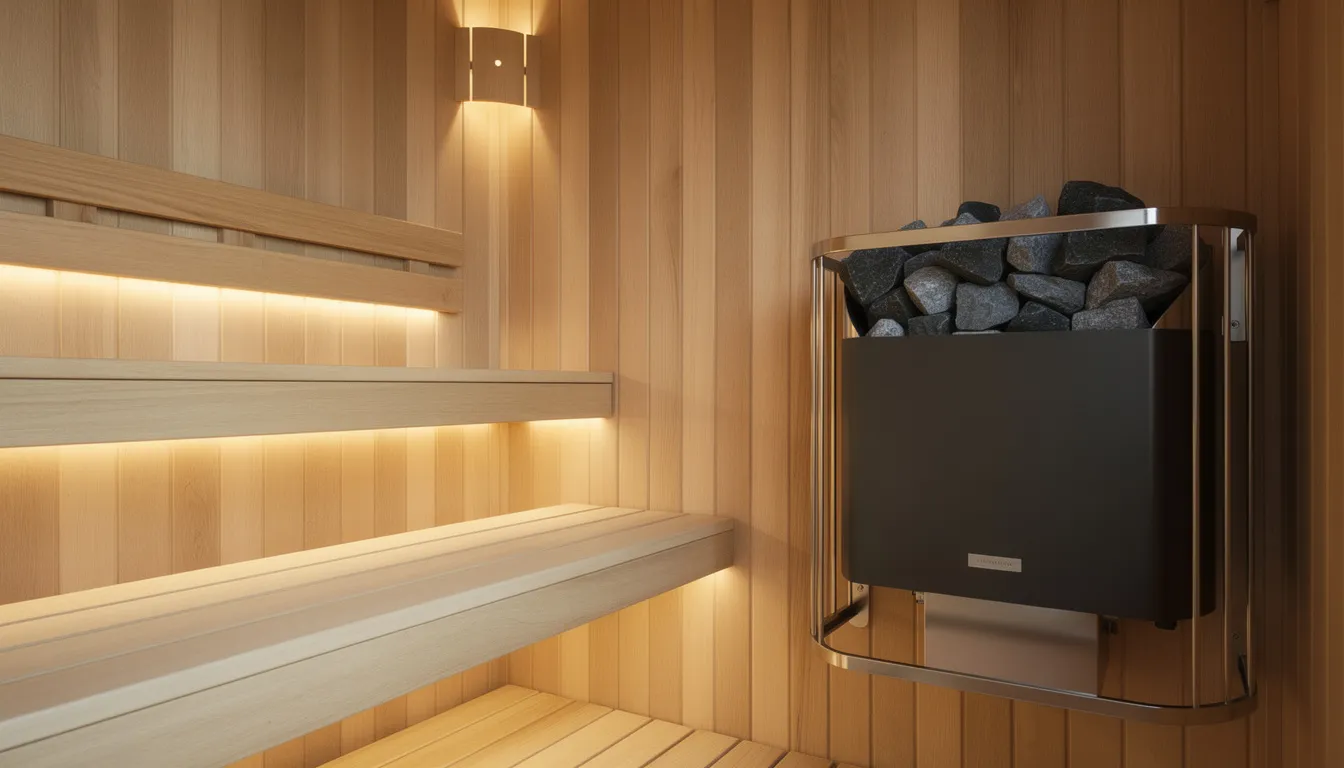
For apartment dwellers, compact backyard cabins, or anyone working with limited floor space, the HUUM STEEL Mini offers ultra-efficient heating in a remarkably slender package. This compact electric tower is designed specifically for tiny saunas up to approximately 140 cubic feet.
The Mini's low power rating of around 3.5 kW is precisely calibrated for these small spaces. When correctly matched to a well-insulated room, it can complete a full sauna session using under 3 kWh. This minimal energy draw makes regular use practical even in areas with higher electricity rates.
Despite its compact size, the STEEL Mini's vertical design maximizes stone-to-air contact. Heat spreads evenly through the small space rather than concentrating at ceiling height.
Like other HUUM models, the STEEL Mini works seamlessly with the UKU controller, including smartphone app functionality. Scheduling short, targeted sessions becomes simple, and you avoid the waste of pre-heating earlier than necessary.
A concrete example: a 120 cubic foot home sauna, 25-minute warm-up, 40-minute session, at $0.15 per kWh works out to roughly $0.45 per session — less than a cup of coffee.
5. HUUM HIVE 9 kW — High Stone Mass for Efficient Family and Commercial Use
The HUUM HIVE takes a different approach to efficiency: massive thermal capacity. The 9 kW variant, designed for larger saunas between 250–530 cubic feet, functions as a thermal battery that stores tremendous heat energy in its substantial rock bed.
This large stone capacity means the heating elements can operate at a lower duty cycle once the rocks are fully saturated with heat. The stones continue radiating warmth long after the elements cycle off, maintaining a stable temperature without constant electrical draw.
For households running several back-to-back sessions or small commercial studios with multiple daily users, the HIVE's efficiency becomes apparent over time. Smaller heaters forced to reheat from scratch for each new user burn more cumulative kWh than a large-capacity unit maintaining temperature between sessions.
Pairing the HIVE with HUUM's UKU Wi-Fi control and optional air circulation systems helps distribute heat evenly throughout the sauna room. Per-session kWh runs higher than compact units (typically 6.0–7.5 kWh), but when calculated per user and per minute of effective comfort, the HIVE often proves more efficient than legacy 10.5–12 kW commercial heaters.
6. Finlandia FIN Series — Reliable Value With Solid Efficiency
Not everyone needs a design-forward heater with app connectivity. The Finlandia FIN series — including the FIN-45 and FIN-60 — delivers straightforward Finnish performance at a lower price point while maintaining respectable efficiency.
These no-frills electric heaters feature industrial-grade heating elements, stainless inner shells, and triple-wall construction that contains heat effectively and reduces radiant loss into wall cavities. Heat stays in your sauna space rather than warming the room behind the wall.
The large rock surface and direct element contact enable quick, even heating. For the FIN-45, expect operating ranges suitable for 100–210 cubic feet. The FIN-60 handles larger home saunas up to approximately 300 cubic feet with standard insulation. Warm-up times generally fall in the 30–45-minute range, depending on room conditions.
For homeowners wanting solid Finnish engineering and predictable electricity bills without paying a premium for design aesthetics or smart home integration, the FIN series represents a smart middle ground.
7. Always-On Sauna Heater Concepts — Efficient for High-Frequency Users
Modern "always on" electric sauna stove designs represent a specialized approach to efficiency that works brilliantly for some users and poorly for others. Units like the Harvia Forte AFB 4.5–6 kW maintain rocks at moderate temperature 24/7 using low-wattage standby elements.
The concept centers on internal super-insulated rock cavities that minimize heat loss. Low-power elements keep stones warm enough that a full-power burst of just 10–15 minutes brings the sauna to usable temperature. For someone taking 1–2 sauna sessions daily, this eliminates the 30–45-minute wait typical of on-demand heaters.
The efficiency of math depends entirely on usage frequency. A 4.5 kW always-on system might draw 0.5–1.0 kW continuously in standby mode — that's 12–24 kWh daily just to stay ready. If you use the sauna twice daily, the quick warm-up might offset this standby draw. If you sauna only once or twice weekly, continuous standby consumption quickly exceeds what an on-demand heater would use.
A 6 kW on-demand unit used three times weekly might consume roughly 15–20 kWh per week total. An always-on system maintaining standby temperature might use 100+ kWh weekly regardless of actual usage.
SunHomeSaunas generally recommends always-on systems only for specific high-use scenarios — commercial studios, dedicated athletes sauna-ing twice daily, or households where multiple family members use the sauna at different times throughout each day.
8. Wood-Burning Stoves — Off-Grid Efficiency With the HUUM HIVE Wood
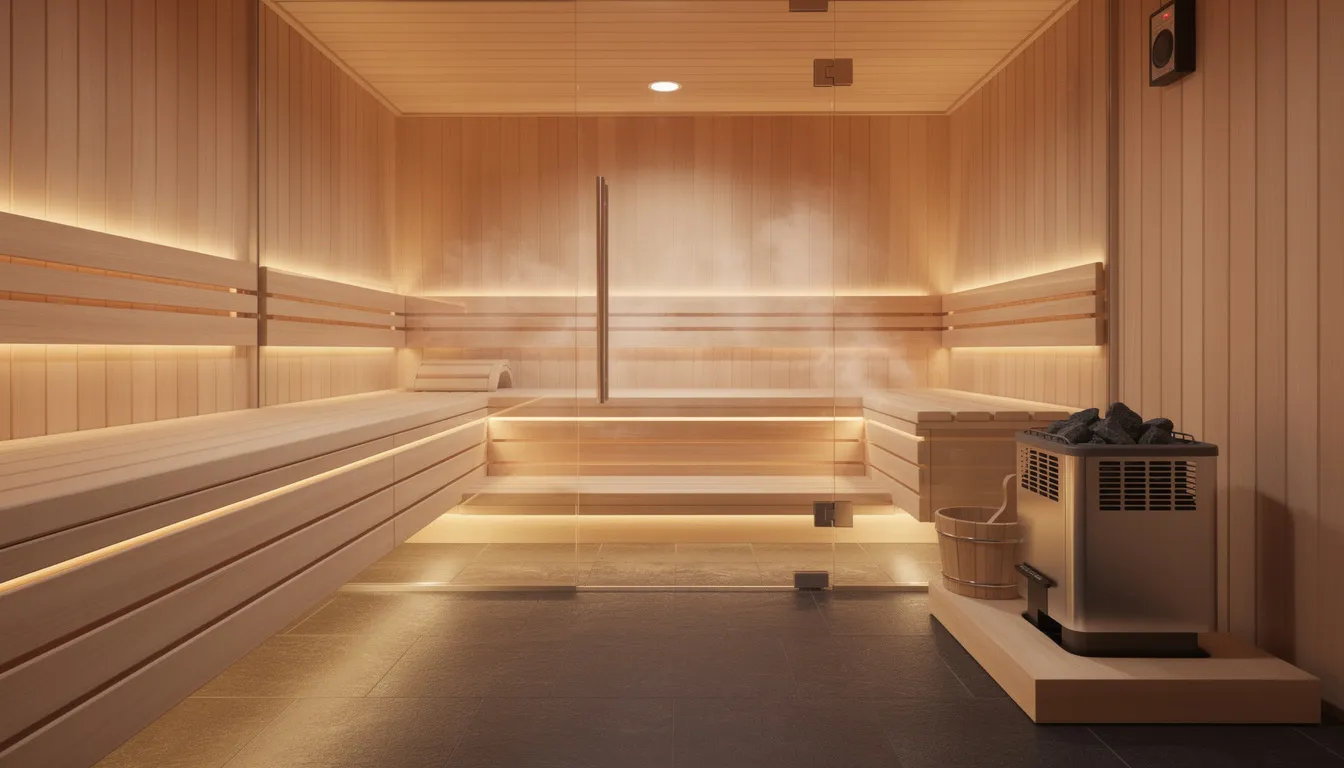
While this article focuses primarily on electric heaters, wood-burning sauna stoves like the HUUM HIVE Wood (approximately 13 kW heat output) deserve mention for their own efficiency considerations. These units don't consume electricity, but they absolutely involve energy efficiency decisions.
High-efficiency firebox designs, secondary combustion chambers, and optimized airflow extract substantially more useful heat per log than basic wood-burning stoves from decades past. Modern wood stoves can achieve 70–80% combustion efficiency compared to 50–60% for older designs — meaning less wood consumed to reach and maintain temperature.
The large rock mass characteristic of quality wood-burning stoves stores heat effectively, reducing the amount of fuel needed to maintain 180–190°F over a typical 2-hour session. For off-grid cabins or locations with cheap or self-harvested wood, these stoves can be extremely cost-effective. A cord of firewood might cost $200–400 and fuel 50–100 sauna sessions, depending on efficiency and session length.
The trade-offs are significant: more manual work (fire tending, ash cleanup), need for proper ventilation and chimney maintenance, and lack of precise temperature control. You can't set a timer and arrive at a perfectly heated sauna — wood demands attention and planning.
SunHomeSaunas can help customers evaluate whether a high-efficiency wood-burning stove or electric heater will be cheaper and more sustainable for their specific location, climate, and usage patterns.
9. Full-Spectrum Infrared Cabin Systems — Low Power, High Utilization
Full-spectrum infrared sauna systems — including near, mid, and far infrared wavelengths — represent perhaps the most efficient path to regular sauna use for many homeowners. Systems like those offered by SunHomeSaunas typically draw just 2–3.5 kW for a 2–3-person cabin.
These systems operate at lower air temperatures (typically 120–150°F) while delivering deep tissue heating through infrared energy absorbed directly by the body. Many users find this provides comparable sweat response and infrared sauna health benefits to traditional saunas at significantly higher temperatures — but with dramatically lower energy consumption.
The efficiency advantage starts with warm-up time. Carbon or ceramic infrared emitters reach operating temperature within 10–15 minutes, compared to 30–45 minutes for traditional rock heaters. This alone cuts pre-session energy overhead substantially.
A concrete example: a 2.1 kW SunHomeSaunas full-spectrum infrared cabin with 10-minute warm-up and 30-minute session uses approximately 1.4–1.7 kWh total. A comparable traditional 6 kW heater for the same duration might consume 4–5 kWh. That's roughly 60–70% energy savings per session.
Additional efficiency features commonly found in quality infrared cabins include low-EMF heater design, tight construction with minimal air leakage, and digital timers that prevent sessions from running beyond intended duration. Infrared sauna detox benefits and muscle recovery goals are fully achievable at these lower temperatures and power levels.
Full-spectrum infrared is ideal for wellness-focused users prioritizing detox, muscle recovery, and low operating costs — particularly in urban homes and apartments where both electrical capacity and monthly bills matter.
10. Far-Infrared Panel Systems — Maximum Efficiency for Compact Home Use
For the most compact applications — infrared sauna 1-person setups in apartments, home offices, or spare bedrooms — simple far-infrared panel systems offer exceptional efficiency. These stripped-down units often use just 1.5–2.0 kW total power while delivering effective heating for single-user sessions.
Wall-mounted carbon panels emit infrared energy directly to your body, minimizing energy wasted heating unused air volume. In a properly designed compact cabin, virtually all electrical input converts to useful warming rather than escaping through walls or ceiling.
The energy math is compelling: a 1.8 kW panel system with 10-minute warm-up plus 30-minute session consumes approximately 1.2 kWh. At $0.15 per kWh, that's about $0.18 per session. Daily use costs roughly $5.40 monthly — practical even in high-electricity markets.
Maintenance requirements are minimal compared to traditional heaters. No sauna rocks to replace, no heating elements exposed to steam and water damage. Many systems offer simple 20A dedicated circuit installation on 120V/20A dedicated circuit (North America) or 230V outlets (Europe).
SunHomeSaunas' construction with low-EMF emitters and insulated wall panels further reduces heat loss and improves comfort at modest power levels. While air temperature feels lower than a traditional Finnish sauna, the perceived body heat and sweat response can be comparable for many users — particularly those focused on infrared sauna health benefits rather than extreme heat exposure.
How Do You Size an Energy-Efficient Heater for Your Sauna?
Correct sizing is the single most important factor in achieving real-world efficiency and comfort. An oversized heater wastes electricity; an undersized one never reaches temperature. Neither scenario delivers the sauna experience you're paying for.
The general rule for traditional electric heaters is approximately 1 kW per 50 cubic feet of sauna volume (roughly 1 kW per 1.4 m³).
Then adjust upward for factors that increase heat loss:
- Example 1: 4' × 6' × 7' sauna (168 cubic feet) with good insulation and minimal glass → 3.5–4.5 kW is appropriate
- Example 2: 5' × 7' × 7' sauna (245 cubic feet) with glass doors and one tile wall → move up to 6 kW to compensate for heat loss
- Example 3: Outdoor barrel sauna with single-wall construction → consider adding 20–30% to base calculation
For infrared saunas, sizing works differently. The key metrics are emitter coverage and watt density at each seating position rather than total air volume. A properly designed 2-person infrared cabin ensures each user receives adequate infrared exposure regardless of exact cabin dimensions.
Resist the temptation to oversize "just in case." A 9 kW heater in a 150 cubic foot sauna doesn't heat faster in a useful way — it overshoots the target temperature, cycles on and off frequently, creates uneven temperatures between the floor and the ceiling, and draws unnecessary peak current.
SunHomeSaunas offers 1:1 sizing support and calculators that match the heater to cabin design, ceiling height, insulation quality, and regional climate. Contact our team to prevent expensive mistakes and ensure you get the perfect fit from day one.
What Else Can You Do to Reduce Sauna Energy Use?
Even the most efficient electric sauna heaters will waste power if the surrounding room is poorly built or used inefficiently. Consider these high-impact improvements.
Lower your ceiling to around 6'6"–7' to reduce total volume and heat stratification — lower ceilings mean less hot air accumulating uselessly above your head.
Seal air leaks around the door and use insulated glass to minimize heat escaping; even small gaps create significant losses over 45-minute sessions.
Pre-heat only as necessary and enter promptly; avoid starting the heater, then getting distracted for 30 minutes while it runs at full power, waiting for you.
Use a thermometer and hygrometer mounted at bench height to monitor actual conditions — many people overheat their saunas because they're checking ceiling temperature rather than where they sit.
For rock heaters, load manufacturer-recommended stone quantity and replace cracked sauna rocks; damaged stones reduce heat transfer efficiency.
For infrared, keep panels unobstructed and clean; dust or towels blocking emitters waste energy.
Ensure adequate but controlled ventilation; too much air circulation forces the heater to work overtime, while too little creates uncomfortable conditions.
Pairing an efficient heater with a high-quality SunHomeSaunas cabin or kit can cut both warm-up time and energy bills substantially compared to retrofitting a poorly insulated garage conversion or basement space.
Why Does SunHomeSaunas Focus on High-Efficiency Sauna Systems?
SunHomeSaunas approaches sauna design with long-term operating costs and sustainability as core priorities. Every cabin and heater recommendation considers not just initial purchase price but the electricity bills you'll pay over the years of regular use.
This philosophy shapes our product selection and design choices. We build with low-EMF, high-output infrared emitters that maximize useful heating while minimizing electrical waste. We select efficient electric rock heaters with appropriate stone capacity for thermal mass and long-lasting steam quality. We use sustainably sourced woods and insulated construction that reduce heat loss through walls and ceiling.
Our customer base includes health-conscious homeowners, competitive athletes, and dedicated biohackers who often use their saunas 4–7 times weekly. At that usage frequency, efficiency differences compound dramatically. A 20% reduction in per-session energy consumption saves hundreds of dollars annually for daily users. This is exactly why the best infrared sauna for home isn't just about peak temperature — it's about what it costs to run it day after day.
Conclusion: Invest in the Most Energy-Efficient Sauna Heaters Available
Choosing among the most energy-efficient sauna heaters isn't just about reducing monthly electricity bills—it's about sustainable wellness that aligns environmental responsibility with long-term affordability and performance.
Over a decade of regular sauna use, the difference between an efficient heater and an energy-hungry model can amount to thousands of dollars in operating costs, making efficiency a crucial consideration alongside therapeutic quality and reliability.
Ready to install one of the most energy-efficient sauna heaters on the market?
Visit SunHomeSaunas today to explore our curated selection of the most energy-efficient sauna heaters for 2026, complete with verified kWh data, lifetime cost projections, and expert sizing recommendations that ensure you choose a system optimized for both your wellness goals and your budget.
FAQs
How much does it cost to run an energy-efficient sauna heater per session?
Cost varies based on heater power, session length, and local electricity rates, but efficient home units typically consume 2–6 kWh per session. A 6 kW electric heater running a 30-minute warm-up plus 30-minute session at approximately 50% average power uses about 4.5 kWh — roughly $0.68 at $0.15 per kWh.
Contrast this with a 2.1 kW infrared cabin running 40 minutes total at approximately 1.4 kWh — just $0.21 at the same electricity rate. Improving insulation and ensuring correct sizing can easily save 20–30% compared to a poorly built sauna using identical equipment.
Are infrared saunas always more energy efficient than traditional electric saunas?
Infrared saunas generally use lower power and require shorter warm-up times, so kWh per session is typically lower — especially for 1–2-person home use. However, traditional Finnish saunas reach higher air temperatures and support features like pouring water over rocks for humidity that infrared cannot replicate.
Traditional saunas may use more total kWh per session but can serve larger groups simultaneously and deliver a different sensory experience. Choice should be based on your preferred sauna experience, health goals, and typical number of users. SunHomeSaunas can help compare realistic operating costs for both options, given your specific usage patterns.
Can I make my existing sauna heater more energy efficient without replacing it?
Yes — often dramatically. Start with your enclosure: improve insulation, lower ceiling height to 7' if possible, seal door gaps, add a proper vapor barrier, and ensure adequate but controlled ventilation that doesn't create unnecessary air exchange.
For your heater specifically, consider adding a modern digital timer or Wi-Fi control where compatible. Scheduling precise pre-heat times and automatic shut-off prevents the efficiency killer of forgetting the heater is running. For rock heaters, clean or replace worn sauna rocks and ensure they're stacked per manufacturer guidance. These changes can reduce power consumption by 15–25% even with older equipment.
Is a lower kW heater always more energy efficient?
No — this is a common misconception. A heater that's too small for your sauna space may run at 100% output continuously, taking 60+ minutes to reach the target temperature. This extended operation can consume more total kWh than a correctly sized unit that warms up quickly and then cycles at a lower duty rate.
Efficiency is about kWh per comfortable session, not just the nameplate power rating. A properly sized 6 kW unit warming up in 30 minutes often uses less total energy than a 4.5 kW unit struggling for 60+ minutes to reach the same temperature in the same space. Size your heater based on volume, materials, and climate rather than simply selecting the smallest available option.
Are gray-market European heaters a good idea if I want efficiency?
No, while some European models appear efficient, importing uncertified gray-market heaters creates significant problems. Safety certifications (UL/ETL) exist for good reason, and bypassing them can create insurance liability and code compliance issues.
Many European heaters run on 400V three-phase power and cannot safely integrate with North American 240V single-phase systems without complex, expensive rewiring. Even if electrical conversion is possible, you'll likely void any warranty and lose access to manufacturer support. Choose certified, region-appropriate models through trusted suppliers like SunHomeSaunas rather than risking problems with DIY gray-market imports.
Sources
- Harvia – "Cilindro PC70 6.8 kW Blacksteel Electric Heater."
- HUUM – "CLIFF Electric Sauna Heater."
- Harvia – "KIP Electric Heater."
- HUUM – "STEEL Mini Electric Sauna Heater."
- HUUM – "HIVE 9kW Mini Electric Sauna Heater."
- Finlandia Sauna – "FIN Series Floor Model Sauna Heater."
- Harvia – "Forte AFB 4.5–6 kW Electric Heater."
- HUUM – "HIVE Wood Burning Stove."
- SunHomeSaunas – "Full Spectrum Infrared Sauna."
- SunHomeSaunas – "Far Infrared Saunas."