


You can fit a sauna in a small bathroom with a footprint as compact as 3' x 4' (approximately 12 square feet). Infrared and full-spectrum cabins are ideal for small spaces due to their 20A dedicated circuit installation and lower moisture load compared to traditional steam units. For a successful conversion, ensure the space has a minimum ceiling height of 7 feet, a dedicated electrical circuit, and a ventilation system capable of 50-80 CFM to prevent humidity buildup
Imagine stepping into your own private sauna after a long day—without leaving your home or sacrificing precious square footage. The dream of a personal wellness retreat isn't reserved for sprawling spa bathrooms anymore. Even the coziest bathroom can become a rejuvenating sanctuary with the right sauna solution.
This article will guide you through the surprisingly achievable process of incorporating a sauna into your compact bathroom space. We'll cover SunHomeSaunas infrared saunas, traditional indoor models, and briefly touch on sauna blankets as options for extremely tight spaces.
Key Takeaways
-
Even a 3' x 4' (about 90 x 120 cm) footprint can fit a one-person infrared sauna in a small bathroom when planned correctly, with minimum dimensions of 48" x 48" for comfortable use.
-
SunHomeSaunas infrared and full-spectrum cabins are typically 20A dedicated circuit (120V or 240V) and avoid the heavy moisture load of steam, making them ideal for compact bathrooms.
-
Three primary layouts work best for small bathrooms: corner unit placement, wall-aligned installation, or conversion over/around an existing tub—each with distinct advantages for different room shapes.
-
Proper ventilation (50-80 CFM exhaust capacity), moisture protection with foil-faced vapor barriers, and dedicated electrical circuits are non-negotiable for every sauna bathroom installation.
-
Infrared sauna 1-person units heat up in 10-15 minutes, compared to 30-45 minutes for traditional models, making them more practical for daily use in compact spaces.
Can You Really Fit a Sauna in a Small Bathroom?
The short answer is yes. Yes, you can fit a sauna in a small room, like a bathroom, with a few expert tips. After all, thousands of urban apartments and small homes built between 2000 and 2024 have successfully done exactly that.
A sauna room doesn't require the sprawling square footage you might imagine. Many SunHomeSaunas customers have integrated 1-2 person units into bathrooms measuring just 30-55 square feet, often working closely with clients to incorporate their preferences and needs into the bathroom design.
A small bathroom can be transformed into a wellness retreat by incorporating the best home infrared sauna, creating a transition from a traditional bathroom to a spa-like space that feels both functional and luxurious.
Size Examples for Small Bathroom Saunas
Here are concrete size examples that prove the point:
|
Sauna Type |
Dimensions |
Minimum Bathroom Size |
|
Compact infrared cabin |
36" x 36" (0.9 x 0.9 m) |
30-35 sq. ft. |
|
Corner unit |
40" x 48" (1.0 x 1.2 m) |
40-45 sq. ft. |
|
Slim wall-mount |
28" deep x 48" wide |
35-40 sq. ft. |
And some more ideas for placement, size and types:
|
Layout Option |
Best For |
Main Advantage |
|
Corner Unit |
Square or awkward bathrooms |
Maximizes unused floor space |
|
Wall-Aligned |
Narrow or rectangular rooms |
Creates a seamless, built-in look |
|
Tub Replacement |
Full renovations |
Uses existing plumbing/drain footprint |
|
Sauna Blanket |
Extremely tight spaces |
Portable and requires zero floor space |
Unlike gym or spa saunas that prioritize capacity over intimacy, a small bathroom sauna offers something different: privacy, daily convenience, and a long-term home sauna wellness investment you can use on your schedule.
There's no driving, no waiting, and no shared space with strangers. You can enjoy the relaxation and stress relief of a sauna in the comfort of your own bathroom.
What Are the Best Layouts for a Small Bathroom Sauna?
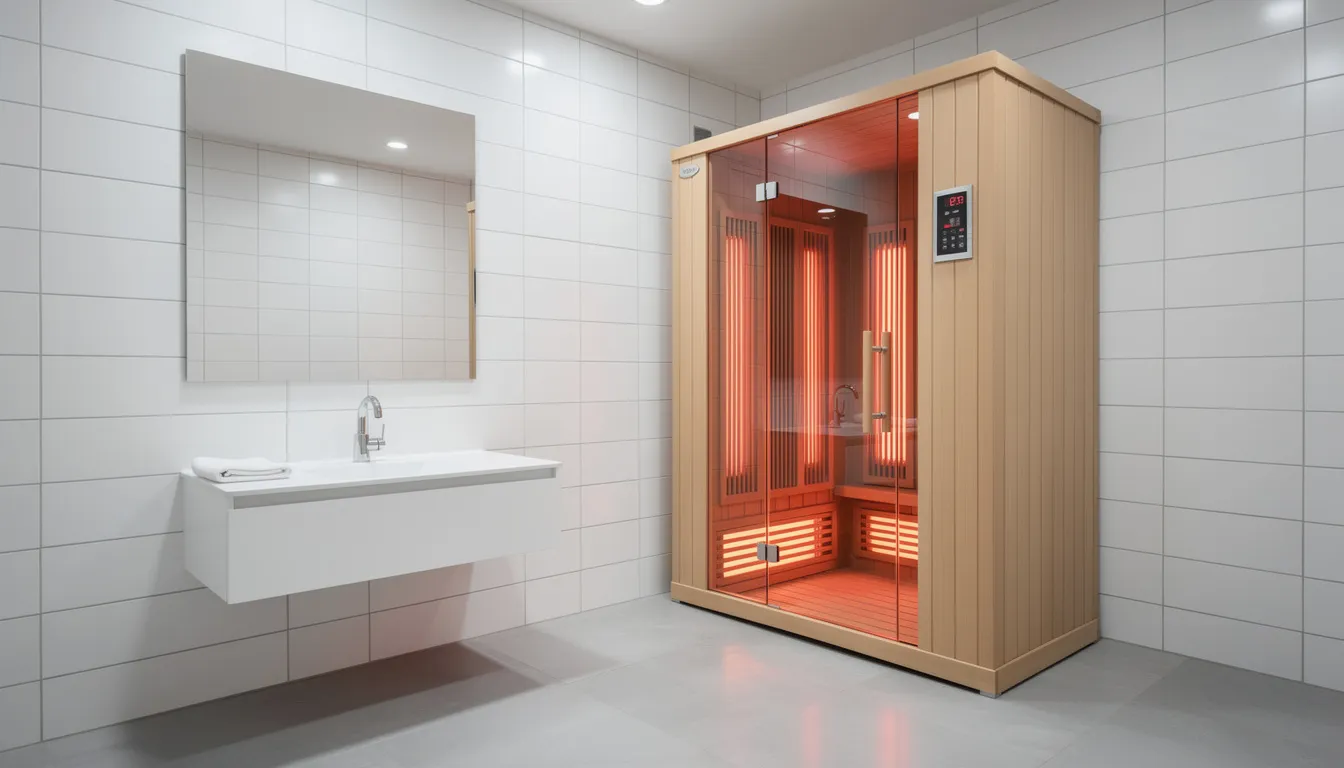
Layout is the single most important decision when planning a luxury home sauna bathroom installation. Innovative bathroom design approaches can help incorporate a sauna into even the smallest spaces, enhancing both function and aesthetics.
Get it right, and your bathroom feels like a boutique spa. Get it wrong, and you'll struggle with awkward circulation paths and cramped functionality.
Typical small bathroom dimensions in North American homes built after 1990 include:
-
5' x 8' (40 sq. ft.) -- most common
-
6' x 6' (36 sq. ft.) -- square layouts
-
5' x 7' (35 sq. ft.) -- compact layouts
-
5' x 9' (45 sq. ft.) -- narrow hallway-style
Three core layout strategies work consistently across these configurations, allowing you to incorporate a home sauna without major change to the existing bathroom footprint:
-
Corner sauna -- Uses triangular or pentagonal units to claim otherwise dead space
-
Wall-adjacent sauna -- Replaces a linen closet or oversized vanity along one wall
-
Raised sauna bench -- Builds over or next to a tub or shower zone
Corner Sauna Layout
A corner sauna works exceptionally well in standard 5' x 8' bathrooms. By placing a triangular or pentagonal unit (with a roughly 40" x 40" footprint) in the far corner opposite the entry door, you claim space that is typically unused.
5' x 8' Corner Sauna Layout
(Top-down view, each character ≈ 1 foot)

Pros of Corner Placement
-
Uses otherwise dead corner space that typically holds nothing
-
Preserves the primary walking path from the door to the fixtures
-
The glass front keeps the room feeling open and bright
-
Works perfectly with SunHomeSaunas' compact infrared sauna 1-person models
Cons to Consider
-
Custom carpentry may be needed for truly angled units
-
Electrical or plumbing may need rerouting away from that corner
-
Slightly less bench depth than rectangular units
Wall-Aligned Sauna Layout
A straight, rectangular 1-2-person sauna (such as 36" deep x 60" wide) fits naturally along the long wall opposite the tub or shower. This layout is ideal when remodeling an older home from the 1980s to 2000s, where a bulky closet or unused alcove can be converted.
5' x 8' Wall-Aligned Sauna Layout
(Top-down view)

A full-height glass door on the sauna preserves visual width in a narrow 5-foot-wide room. Position benches along the long side to allow one or two people to recline or sit with legs fully supported for maximum 2-3-person home sauna benefits.
Sauna Over or Adjacent to Bathtub Layout
For extremely tight bathrooms around 5' x 7', consider building a raised, enclosed sauna platform above one end of an existing alcove tub. This creates a multi-level wet room concept.
5' x 7' Raised Sauna Layout
(Side/top hybrid view)

This solution requires robust waterproofing, structural framing rated for the weight of occupants and sauna materials, and local code verification in accordance with International Building Code standards. It's often best executed during a complete renovation or new build.
How Do You Plan Room Layout and Furniture Placement?
This section expands on the earlier sauna layout concepts with more explicit visual planning. Use these as templates to sketch your own bathroom on grid paper, using one square = 6" or 10 cm, then place scaled sauna footprints to test different positions.
To further optimize your small bathroom sauna, retractable sauna benches can be included to maximize space when the sauna is not in use. Foldable solutions, such as portable sauna tents, can also be included to free up floor space when not in use.
Example Layout 1: 5' x 8' with Corner Infrared Sauna
This detailed layout shows how a 36" x 36" SunHomeSaunas infrared cabin fits in the corner of a standard bathroom.
5' x 8' Detailed Layout
(Each row ≈ 1 foot)

Circulation Notes
-
Sauna door faces center, keeping movement intuitive: door → vanity → toilet → bath → sauna
-
Minimum 24-30" clearance in front of sauna door
-
21" clearance in front of the toilet per the standard code
Accessory Placement Ideas
-
Towel hooks on the wall between the sauna and the tub
-
Small shelf above toilet for sauna essentials
-
Robe hook on the back of the entry door
Example Layout 2: 6' x 6' with Sauna Opposite Shower
This square-room layout creates a modern wet-room style, with the sauna and shower occupying opposite corners.
6' x 6' Square Layout

The upper left corner houses a 4-foot-wide full-spectrum infrared sauna, while the lower right corner becomes a curbless shower zone. A glass partition between the shower and sauna keeps the room feeling open and spa-like.
Example Layout 3: Narrow 5' x 9' with Sauna Along One Long Wall
Hallway-style bathrooms present unique challenges, but they can actually work beautifully for sauna installation when you use the back wall.
5' x 9' Narrow Layout

The sauna occupies the back 3 feet of the long wall, with its door facing the central circulation area. A recessed or floating vanity keeps the central path at least 30 inches wide.
What Type of Sauna Works Best for Small Bathrooms?
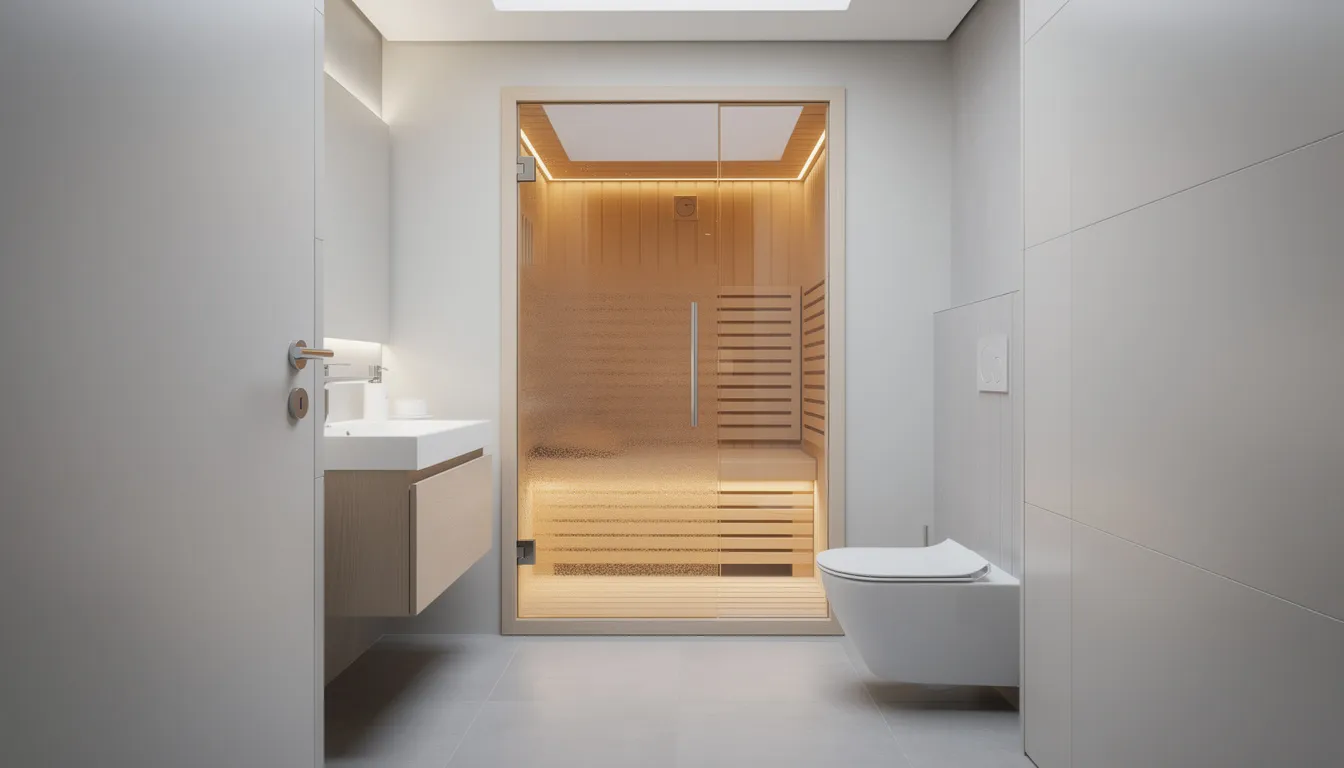
When working with bathrooms under 60 square feet, the type of sauna you choose matters as much as the layout. The decision affects everything from electrical requirements to moisture management to daily convenience.
SunHomeSaunas specializes in low-EMF infrared systems and compact traditional units designed for performance and safety in small rooms. Here's how the options compare:
|
Feature |
Infrared |
Traditional Electric |
Hybrid |
|
Operating temp |
120-140°F (49-60°C) |
160-190°F (71-88°C) |
Variable |
|
Heat-up time |
10-15 minutes |
30-45 minutes |
15-25 minutes |
|
Typical power |
1.7 kW (120V) |
3-4.5 kW (240V) |
2-3 kW |
|
Moisture output |
Low |
Moderate-High |
Variable |
|
DIY-friendly |
Yes |
Requires electrician |
Electrician recommended |
Steam rooms and heavy steam generators demand more extensive waterproofing and ventilation than many small-bath retrofits can easily provide. For most clients with limited space, an infrared or a compact traditional heater offers the best balance.
Infrared and Full-Spectrum Saunas
Infrared heaters warm your body directly rather than heating the air around you. This means they operate at lower air temperatures (typically 120-140°F) while still delivering deep, penetrating heat for maximum infrared sauna health benefits.
Why Infrared Suits Small Bathrooms
-
Faster warm-up times (10-15 minutes vs 30-45)
-
Less moisture load on finishes and fixtures
-
More flexibility with layout and materials
-
Many models run on standard 120V, 15-20A household circuits
SunHomeSaunas offers compact 1-2-person infrared units specifically designed for bathroom installations. Slim panel heaters can be integrated into narrow wall cavities or custom-built niches for a minimalist look that doesn't overwhelm a small room.
Traditional Electric Saunas in Small Bathrooms
Traditional electric saunas operate at higher air temperatures (160-190°F) and create the classic experience of löyly—the burst of steam when water hits hot rocks. This experience requires more attention to insulation and ventilation.
Common Heater Sizes for Small Cabins
-
3 kW -- suits 3' x 4' rooms
-
4.5 kW -- suits 4' x 5' rooms
-
Use the "200 rule" to calculate: (Length + Width + Height in feet) × 200 = watts needed
SunHomeSaunas' traditional models use quality heaters designed for efficient heat distribution and safe clearances from walls and benches.
Hybrid and Multi-Use Solutions
Hybrid solutions combine infrared panels with a traditional heater or integrate red light therapy panels into the cabin for enhanced benefits.
When Hybrid Makes Sense
-
Wellness enthusiasts wanting maximum versatility
-
Households where different family members prefer different temperatures
-
Those interested in the sauna red light therapy kit as an add-on
-
Spaces that are too small for two separate wellness installations
Note that hybrids may require more complex electrical planning and careful heater placement in compact rooms.
What Design and Materials Work Best?
Small bathrooms magnify every design choice. The materials, colors, and textures you select can either make the space feel cramped and cluttered or create a serene, spa-like atmosphere that exceeds its square footage.
SunHomeSaunas focuses on premium, sustainable woods like Canadian hemlock, Nordic spruce, and cedar, paired with low-VOC finishes that are safe even at elevated temperatures. Combined with moisture-resistant surfaces like porcelain tile and tempered glass, these materials create a bathroom that's both beautiful and durable.
Wood Species and Interior Finishes
The wood inside the best home sauna brands 2026 affects not just aesthetics but also aroma, heat retention, and long-term durability.
|
Wood Type |
Benefits |
Best For |
|
Nordic spruce |
Light color, stable, minimal resin |
Bright, airy feeling |
|
Canadian hemlock |
Hypoallergenic, subtle grain |
Allergy-sensitive users |
|
Basswood |
Very light, soft to touch |
Ultra-minimal aesthetics |
|
Western red cedar |
Natural aroma, rot-resistant |
Traditional character |
SunHomeSaunas prioritizes sustainably sourced woods and integrates low-EMF heaters within these materials for maximum comfort and safety.
Glass, Doors, and Visual Space
Floor-to-ceiling glass doors or partial glass walls visually expand small bathrooms, showcasing them as design features rather than awkward additions.
Glass Specifications
-
Tempered safety glass (8-10 mm thickness) is standard for sauna doors
-
Clear glass maximizes light; lightly tinted adds privacy
-
Frameless or minimal-frame designs with discreet hinges create a streamlined look
-
Simple wooden or matte black pull handles complement modern bathroom aesthetics
Color, Lighting, and Accessories
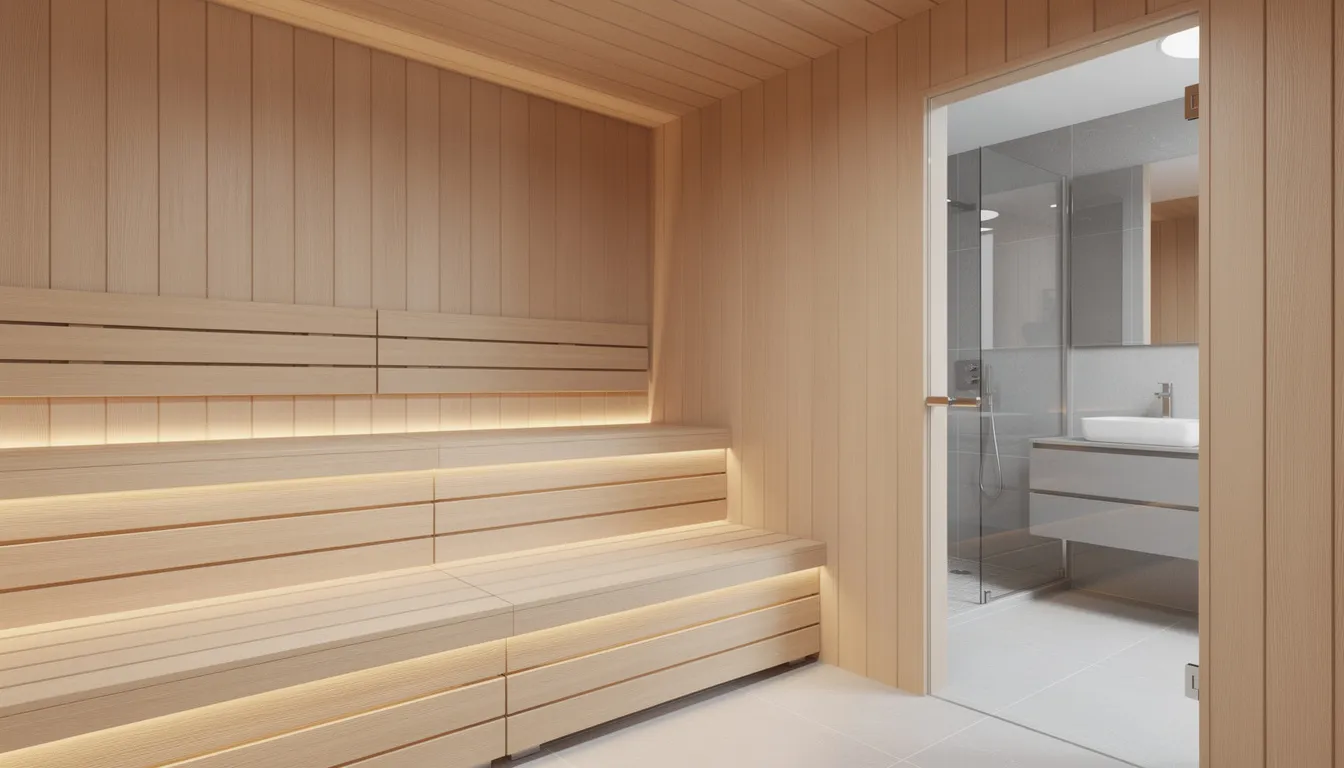
The right color palette and lighting can transform even the smallest sauna bathroom into a calming retreat.
Color Recommendations
-
White or light grey porcelain tiles for floors and walls
-
Pale oak or hemlock wood tones
-
Black or bronze fixtures for contrast
-
Avoid dark colors that shrink the perceived space
Lighting Strategies
-
Indirect LED strip lighting under sauna benches
-
Backrest lighting for ambient glow during sessions
-
Under-vanity LEDs instead of harsh overhead fixtures
-
Consider sauna red light therapy kit panels in the sauna as a wellness add-on
What Are the Practical Ventilation and Safety Considerations?
Comfort and safety are non-negotiable in tiny wet spaces, especially when adding heat. Good mechanical ventilation and a clear moisture strategy prevent mold, peeling paint, and structural issues that can cost thousands to repair.
All electrical work must be performed by a licensed professional familiar with local code and bathroom wet-zone regulations, in accordance with the National Electrical Code.
Ventilation and Moisture Management
Even infrared saunas, which generate less steam than traditional units, benefit from proper air exchange for comfort and longevity.
Exhaust Fan Requirements
-
Minimum 1 CFM per square foot of bathroom space
-
Higher capacity (50-80 CFM) recommended for sauna bathrooms
-
Timer switch to run 20-30 minutes after sauna sessions
-
Duct to exterior, not into the attic
Moisture Protection Layers
-
Foil-faced vapor barrier with shiny side facing into the sauna
-
Minimum 4-inch overlap on all seams, sealed with aluminum foil tape
-
Moisture-resistant gypsum board behind tile
-
Fully sealed corners around the sauna area
Electrical and Heat Safety
Electrical safety in a sauna bathroom requires careful planning and professional installation.
Circuit Requirements
-
Dedicated circuits for all sauna heaters
-
GFCI protection where local code requires
-
Typical loads: 1.7 kW for compact infrared (120V), 3-4.5 kW for traditional (240V)
Clearance Guidelines
-
2-4 inches from the infrared panels to the benches and walls
-
Greater distances for traditional heaters (check manufacturer specs)
-
No outlets or switches inside the sauna unless specifically rated
-
Switches positioned outside direct splash zones
Comfort: Benches, Heights, and Ergonomics
Comfort in a small sauna depends heavily on bench design and positioning.
Standard Comfort Guidelines
-
Sitting bench height: 18-20 inches
-
Foot bench height: 12-16 inches
-
Backrest angle: slight recline for relaxed posture
-
Bench slats: spaced ½ inch apart for airflow and drainage
What Real-World Examples Show Success?
Theory is helpful, but seeing how real scenarios come together provides the inspiration many clients need. These case-style concepts reflect common situations—urban condos, family homes, and primary suite renovations—with specific SunHomeSaunas products and practical details.
Urban Condo: 5' x 8' Bathroom with 1-Person Infrared Cabin
The scenario: A 2024 retrofit in a city condo where space is at a premium but wellness isn't negotiable.
The solution:
-
36" x 36" SunHomeSaunas infrared sauna 1-person unit replaces an unused shelving unit near the tub
-
Existing bathroom exhaust fan upgraded to 70 CFM with a timer
-
120V dedicated circuit added by a licensed electrician
-
Light hemlock wood, frameless glass sauna door
-
Large light-grey tiles maintain brightness
The experience: The owner uses the sauna for 20-30 minute sessions after work, integrating it into a daily stress-relief routine.
Family Home: 6' x 9' Bath Converted to a Mini Spa
The scenario: A suburban home built in the early 2000s, where a 6' x 9' hall bathroom felt dated and underutilized.
The solution:
-
2-person SunHomeSaunas full-spectrum infrared sauna for sale unit installed opposite a new walk-in shower
-
Matching porcelain tile and cedar interior creates visual cohesion
-
Floating vanity and wall-hung toilet open floor space
-
Small cooling bench and towel storage niche added
-
Cold "contrast" shower head installed next to sauna
The experience: Both adults and teenagers share the sauna for recovery after sports and workouts. The combination of heat and cold therapy has become a family wellness ritual.
Primary Suite: Sauna Integrated with Balcony Access
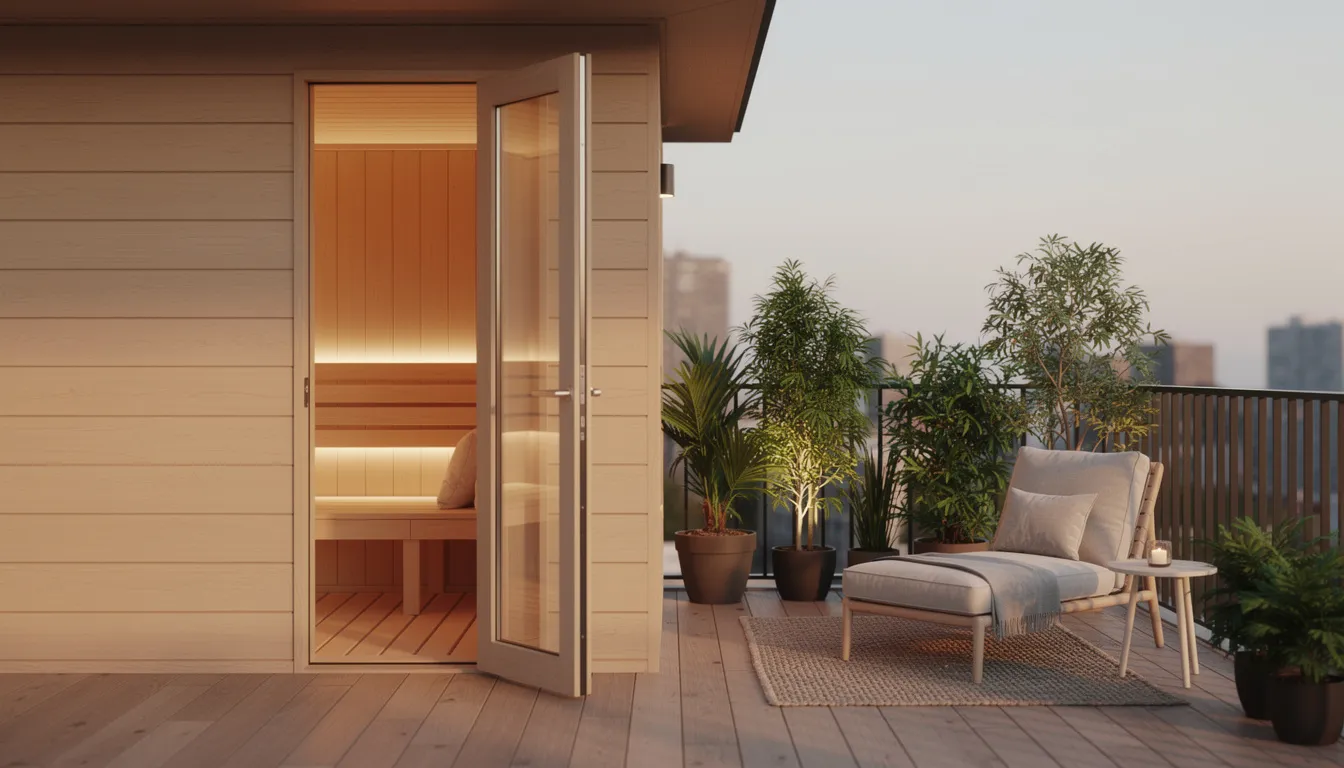
The scenario: A primary bathroom completed around 2022 in a home with a private outdoor space.
The solution:
-
Small corner sauna placed near a glass door leading to a private balcony
-
The layout allows fresh-air breaks between heat cycles
-
Frosted balcony glass maintains privacy
-
Natural wood finishes connect indoor and outdoor aesthetics
Future options: SunHomeSaunas' outdoor products offer complementary options if the homeowner later decides to install a separate exterior sauna or cold plunge tub.
How Do You Work with SunHomeSaunas for Installation?
Bringing a small bathroom sauna from concept to reality requires careful planning, but you don't have to figure it out alone. SunHomeSaunas works closely with each client to customize bathroom layouts and sauna features, ensuring the final design meets their specific needs and preferences.
Planning Steps
Before contacting SunHomeSaunas, gather these measurements:
Step 1: Measure your room
-
Length, width, and ceiling height (ideally 7' or higher)
-
Note any alcoves, closets, or unused corners
Step 2: Document existing infrastructure
-
Locate plumbing lines and drains
-
Identify electrical outlets and panel capacity
-
Note existing ventilation (exhaust fan location and CFM rating)
-
Photograph windows and their positions
Step 3: Sketch the room to scale
-
Use grid paper with one square = 6" or 10 cm
-
Mark all fixtures: toilet, vanity, tub/shower, door
-
Note door swing directions
Installation and Ongoing Care
Most SunHomeSaunas kits are modular and can be assembled on-site, which is particularly valuable when navigating tight stairwells and hallways common in urban buildings.
Installation Timeline
-
Compact infrared unit: typically, 3-4 hours for two people
-
Electrical hookup: additional time varies by complexity
-
Traditional sauna with custom framing: 1-2 days
Ongoing Care Guidelines
-
Wipe benches with a damp cloth after each use
-
Use non-abrasive cleaners monthly
-
Leave the sauna door slightly open after sessions to dry out
-
Periodically check heater connections and door seals
-
Verify ventilation is functioning properly
Transform Your Small Bathroom into Your Personal Wellness Oasis
Your small bathroom doesn't have to be a limitation—it's an opportunity to create an intimate, personalized wellness retreat tailored perfectly to your space and lifestyle. With infrared saunas, clever layout strategies, and modern compact designs, you now have all the tools you need to bring the transformative benefits of sauna therapy into your daily routine.
Ready to turn your compact bathroom into the spa sanctuary you've always dreamed of? Visit SunHomeSaunas today to explore premium space-saving sauna solutions designed specifically for small bathrooms, and discover how good "me time" can truly feel.
References and Citations
- Home Sauna – Top tips for installing a sauna in small spaces
- International Building Code (IBC) 2021 – Structural and safety requirements for bathroom sauna installations
- National Electrical Code (NEC) – Electrical installation standards for wet locations
- U.S. Energy Information Administration – Residential electricity usage and cost data
- Home Sauna – A guide to the best sauna layouts for modern homes