

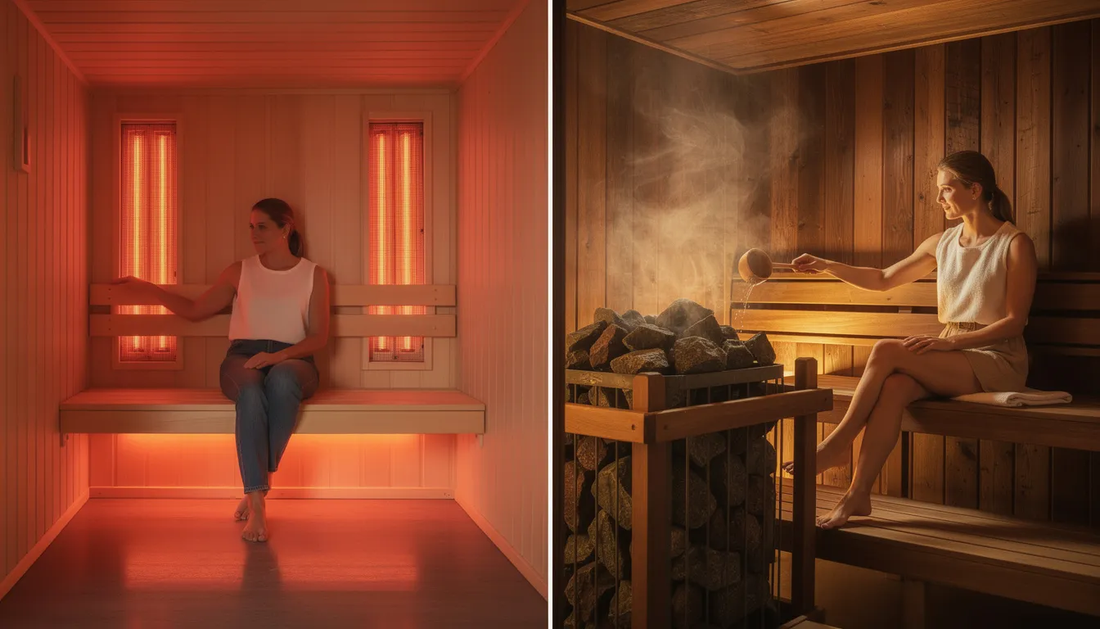
In 2026, choosing between infrared vs. traditional home saunas depends on your wellness goals and heat tolerance. Infrared models offer gentle, radiant warmth and lower EMF levels for daily recovery, while traditional saunas provide intense heat and steam. Compare costs, installation, and benefits to find the best home sauna for your space.
Infrared vs Traditional: Which Is the Best Home Sauna 2026?
For most home buyers in 2026, an infrared sauna is the easier, more flexible choice: it warms your body with radiant heat at lower operating temperatures (typically around 140°F), some models run on a standard 120V outlet, and sessions feel gentle. A traditional sauna wins when you want the hottest, most intense experience — high air temperatures plus the steam burst (löyly) you get by pouring water on hot rocks — but it needs higher voltage and more ventilation. The good news: you don't have to choose a brand by type. Sun Home offers both infrared (Eclipse, Luminar, Pod, Equinox, Solstice) and a traditional line (Solaris), so you can pick the experience you want.
- Infrared = gentle, lower-temperature radiant heat. Infrared "use[s] light waves to heat a person's body, not the entire room," usually at about 60°C (~140°F) (Medical News Today).
- Traditional = higher peak heat + steam. Traditional saunas run hot — "158–212°F (70–100°C)" per Medical News Today; the North American / Finnish Sauna Society notes a sauna should be at least 150°F, with a worldwide trend toward lower temperatures (Sauna Society).
- Install is usually simpler for infrared. Sun Home's Eclipse 2 and Pod run on 120V circuits; the Solaris traditional line needs a 240V supply (Sun Home product data).
- Low EMF is independently tested. Sun Home infrared saunas were tested by Vitatech Electromagnetics at roughly 0.3–0.9 mG at a typical 3-ft seated position (Sun Home low-EMF testing).
- One brand, both types. Best overall infrared: Eclipse 2. Best traditional: Solaris.
How infrared and traditional saunas actually differ
The core difference is what gets heated. A traditional sauna heats the air and a bank of rocks with a high-output stove; you sit in very hot air and can pour water over the rocks to create a burst of steam known as löyly. An infrared sauna skips the hot-air approach: it uses infrared heaters to warm your body directly. As Medical News Today explains, infrared saunas "use light waves to heat a person's body, not the entire room," while traditional saunas heat the surrounding air — and, importantly, "the person sweats in a similar way" in both (Medical News Today).
That mechanism drives the temperature gap. Traditional saunas run hot: Medical News Today describes a traditional sauna as "a room heated to between 70° to 100° Celsius or 158° to 212° Fahrenheit," whereas an infrared sauna "is usually… about 60° Celsius" (~140°F) (Medical News Today). The North American / Finnish Sauna Society notes that a sauna "must be at least 150°F (65.5°C)," and that sauna bathing "trends worldwide lean towards lower temperatures" (saunasociety.org). Sun Home's own infrared lineup sits in that radiant range, with published maximums from up to 149°F on the Pod to 0–170°F on the Luminar (Sun Home product data).
Neither approach is "better" in the abstract — they're different experiences. Infrared trades peak heat for comfort and flexibility; traditional trades convenience for intensity and the steam ritual.
Infrared vs traditional: side-by-side comparison
| Dimension | Infrared (incl. Sun Home) | Traditional |
|---|---|---|
| Heat mechanism | Radiant — heats your body, not the room (MNT) | Heats air + rocks; steam (löyly) when water is added (MNT) |
| Operating temperature | ~140°F typical (MNT); Sun Home published max 149–170°F by model (products-api) | 158–212°F (70–100°C) — Medical News Today |
| Electrical | 120V options exist — Eclipse 2 is 120V / 2,820W / 23.5A; Pod is 120V / 1,710W / 14.2A (Sun Home data) | High-output stove needs 240V — Solaris S is 240V / 25A; Solaris M is 240V / 40A (Sun Home data) |
| EMF | Sun Home tested by Vitatech at ~0.3–0.9 mG at a 3-ft seated position (Sun Home) | Resistive stove; we don't publish a measured number for traditional units |
| Experience | Gentle radiant warmth, comfortable longer sessions at ~60°C (MNT) | Intense, very hot air + steam; "sweats in a similar way" (MNT) |
| Install footprint | Indoor 120V infrared is simplest to place (Sun Home data) | Needs 240V circuit, clearances, and ventilation (Sun Home Solaris data) |
| Price | Entry-level to premium tiers — see live PDP* | Mid-range to premium — see live PDP* |
| Brand fit | Sun Home sells both types — pick your experience without switching brands | Same — Solaris covers the traditional side in-house |
*Sun Home runs a near-perpetual sale, so the displayed price changes — always check the live product page for current pricing. Sources: Medical News Today; North American / Finnish Sauna Society; Sun Home product data (products-api.sunhomies.com).
Best home sauna by type and use case
Because Sun Home builds both infrared and traditional saunas, you can match the unit to how you'll actually use it — without leaving the brand. Here's how we'd guide a 2026 buyer across the lineup. (Specs below are quoted from Sun Home's live product data; prices are intentionally omitted because they change with the current sale — check each product page.)
An indoor infrared sauna with integrated Red Light Therapy, a 0–165°F temperature range, 6 far-infrared plus 2 full-spectrum heaters, and Canadian Red Cedar wood. It runs on a 120V / 2,820W / 23.5A circuit (NEMA L5-30P), so most homes can place it without a 240V upgrade. The mix of radiant heat, red light, and standard-outlet flexibility makes it our default pick for first-time infrared buyers.
Sun Home's flagship outdoor infrared line, built with aerospace-grade aluminum exterior paneling, Canadian Red Cedar interior, and thick double-pane black glass. It carries the highest published infrared maximum in the lineup at 0–170°F. The Luminar 2 is 240V / 4,800W / 20A; the Luminar 5 is 240V / 7,200W / 30A — so plan for a dedicated outdoor circuit.
A 1-person indoor far-infrared sauna with a circular 360-degree design, 11 carbon far-infrared heaters across 4 zones, a built-in red light panel, and Canadian hemlock wood. It heats up to 149°F and runs on a 120V / 1,710W / 14.2A circuit (NEMA 5-20P) — the lightest electrical footprint here, ideal for apartments and small rooms.
If you want true high-heat, steam-capable sauna sessions, the Solaris is Sun Home's handcrafted, made-to-order traditional outdoor line with high-output HUUM Wi-Fi-enabled heaters and pre-assembled delivery. It is a traditional sauna — not infrared — so it delivers the hot-air-plus-löyly experience the sauna societies describe. Solaris S is 240V / 25A and seats 2–4; Solaris M is 240V / 40A and seats 4–6.
Want to browse the full infrared range first? Start with the infrared sauna collection, or read our companion guides to the best infrared saunas of 2026 and the best home sauna of 2026.
What the research says about the benefits
Most published long-term sauna research studies traditional Finnish saunas, not infrared cabins. The best-known body of work — a long-running Finnish cohort published in JAMA Internal Medicine (Laukkanen et al., 2015;175(4):542) — is observational research on traditional sauna users, and it reports that frequent sauna bathing was associated with certain cardiovascular outcomes.
Two cautions matter here. First, "associated with" is not the same as "causes," because observational studies can't rule out other lifestyle factors. Second, findings from a traditional Finnish sauna cohort don't automatically transfer to an infrared cabin, which runs at lower temperatures with a different heat mechanism. We're reporting what the research found, not claiming any Sun Home product treats, prevents, or cures anything.
For a balanced overview of sauna types and their reported effects, Medical News Today's infrared sauna guide is a good, plain-language starting point. The honest summary for 2026 buyers: many people find sauna sessions relaxing and enjoyable, the traditional-sauna observational evidence is interesting but not proof of cause, and you should treat a sauna as a wellness and comfort purchase rather than a medical intervention. See the references below for the primary sources, and read them yourself.
Build quality, materials, and EMF
Sun Home's infrared cabins use Canadian Red Cedar (Eclipse and Luminar) or Canadian hemlock (Pod), with a trademarked black exterior on the modern lines. On the EMF question that comes up often with infrared: Sun Home's heating technology was independently tested by Vitatech Electromagnetics, which measured roughly 0.3–0.9 mG at a typical 3-ft seated position (low-EMF testing details). We tie that number to the seated distance on purpose — EMF readings change with distance, so a figure without a distance is meaningless.
Traditional saunas like the Solaris use a resistive electric (or wood) stove and don't carry the same infrared-heater EMF question; we don't publish a measured EMF figure for traditional units, and we won't invent one.
Installation and running costs
The biggest practical difference for a home buyer is electrical. Several Sun Home infrared models — the Eclipse 2 (120V) and the Pod (120V) — can run on a standard household circuit, which often means no electrician and no panel upgrade. Larger infrared units (Eclipse 4, the Luminar outdoor line) and the traditional Solaris all require a 240V supply: Solaris S draws 25A and Solaris M draws 40A, so a dedicated circuit and proper outdoor clearances are part of the plan (Sun Home product data).
On price and running cost: we don't quote dollar figures in this guide on purpose. Sun Home runs a near-perpetual sale, so the price shown on any given day depends on the live promotion — always check the current product page for the model you want. As a rough rule, infrared lines span entry-level to premium tiers, while the handcrafted Solaris traditional line sits toward the premium end.
Safety and support
Whichever type you choose, follow the basics: hydrate, keep sessions to a comfortable length, don't bring electronics into a hot infrared cabin, and talk to your doctor before sauna use if you're pregnant or have a medical condition. Sun Home's infrared cabins are backed by a Lifetime Limited Warranty (per current product data); always confirm the specific warranty terms on the product page for the model and line you're buying.
The bottom line
Choose infrared if you want gentle, comfortable radiant heat at lower temperatures (~140°F per MNT), the flexibility of a 120V model, and a simpler indoor install. For most home buyers, that's the Eclipse 2 (best overall), the Luminar for outdoors, or the Pod for tight spaces.
Choose traditional if you want the hottest possible sessions (158–212°F per Medical News Today) and the steam-and-löyly ritual. That's the Solaris, which delivers a genuine high-heat experience infrared can't match.
Because Sun Home builds both, you can pick the experience you want — not the brand that happens to make only one kind. Check live pricing on each product page before you buy.
Frequently asked questions
References
- Medical News Today — "Infrared sauna: Health benefits, risks, and what to expect." https://www.medicalnewstoday.com/articles/313109
- North American / Finnish Sauna Society — "The Sauna Experience" (minimum sauna temperature and the worldwide trend toward lower temperatures). https://www.saunasociety.org/sauna-experience
- Laukkanen et al., JAMA Internal Medicine, 2015;175(4):542 — observational cohort of traditional Finnish sauna use. https://jamanetwork.com/journals/jamainternalmedicine/fullarticle/2130724
- Genuis et al., 2011 — "Blood, Urine, and Sweat (BUS) Study," Archives of Environmental Contamination and Toxicology 61(2):344–357 (toxicant excretion in sweat; early/limited evidence).
- Sun Home Saunas — low-EMF testing (Vitatech Electromagnetics). https://sunhomesaunas.com/pages/low-emf-infrared-sauna
- Sun Home Saunas product data — Eclipse, Luminar, Pod, and Solaris specifications (temperatures, electrical, heaters, materials), products-api.sunhomies.com.

