

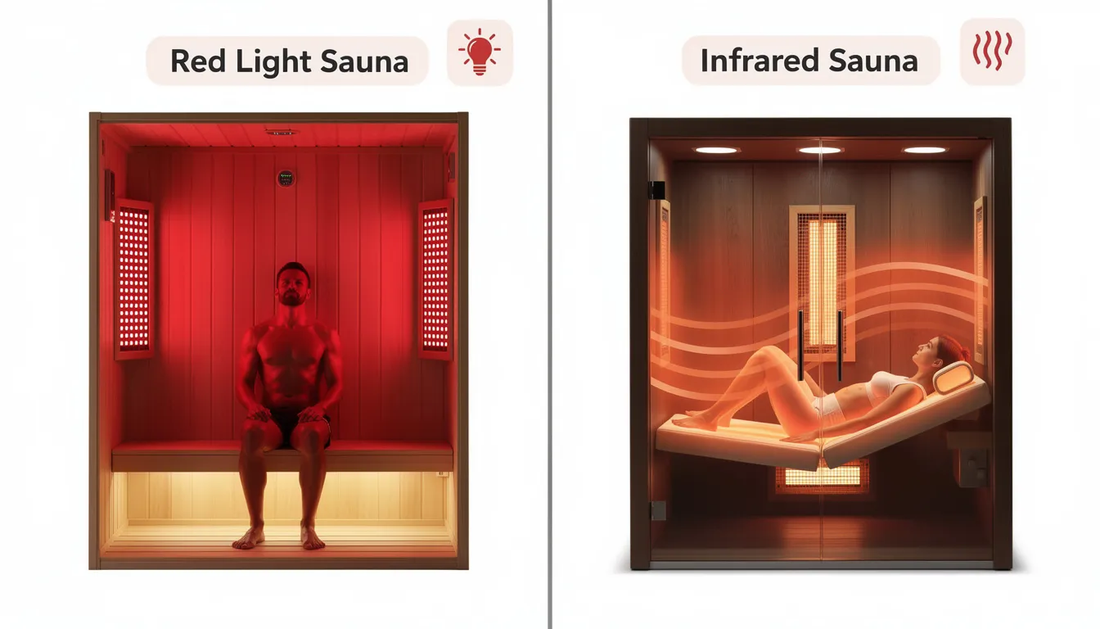
Choosing between red light therapy and an infrared sauna depends on your specific wellness goals. Red light therapy uses LEDs to target skin rejuvenation and cellular repair through photobiomodulation. In contrast, infrared saunas provide deep thermal heat for whole-body detoxification, cardiovascular health, and stress relief. For the most comprehensive results, integrated systems combine both technologies into one immersive home wellness experience.
Red Light Sauna vs Infrared Sauna: Which Is Best for You?
Quick answer: A "red light sauna" is a standard infrared sauna cabin with red and near-infrared LED panels built in, so heat and light run in one session. A standard infrared sauna delivers radiant heat only, with no dedicated therapeutic LEDs. Compared with an otherwise similar heat-only infrared sauna, a red light sauna provides the same core sauna function — radiant heat and sweating — while adding dedicated red and near-infrared LEDs; exact heater configurations, temperatures, and sweating vary by model and user. The primary functional difference is whether dedicated light panels are added. Choose a standard infrared sauna if your goal is whole-body heat, and a red light sauna if you also want targeted light therapy in the same session. (A third option, a standalone red light panel, provides light with no heat — useful context, but not the focus of this comparison.)
Published January 22, 2026 · Updated July 15, 2026
Disclosure: This guide is published by Sun Home Saunas, which designs and sells infrared saunas and red light therapy products, including several models referenced later in this article. We aim to describe both technologies accurately regardless of what a reader buys. Product-specific details are confined to a clearly labeled section near the end so the comparison itself stays neutral.
Key takeaways
- A red light sauna is an infrared cabin with integrated red and near-infrared LED panels; a standard infrared sauna uses infrared heaters alone, with no dedicated light panels.
- In otherwise comparable models, the heat, temperature range, and sweating are effectively the same. The red light sauna simply adds light therapy alongside the heat.
- Pick a standard infrared sauna for whole-body heat sessions and the relaxation, circulation, and heat-adaptation benefits associated with them.
- Pick a red light sauna if you also want dedicated red/near-infrared light exposure and prefer to combine both in a single session rather than owning a separate light panel.
- Evidence for heat therapy and for photobiomodulation (red/near-infrared light) comes from separate research bases, and much of the strongest heat data comes from traditional Finnish saunas, not infrared cabins. We keep those distinct below.
- Both are generally well tolerated by healthy adults. People who are pregnant or who have cardiovascular conditions, heat sensitivity, or photosensitivity should consult a clinician first.
Red light sauna vs. infrared sauna: what's actually being compared?
Most of the confusion in this category comes from loose labels. Three different things get called "red light" or "infrared," and they are not interchangeable:
- Standalone red light therapy — a wall panel, handheld unit, or mask that emits red and near-infrared light through LEDs. It produces almost no heat and no sweating. Its purpose is light exposure, not a heat session.
- Standard infrared sauna (heat only) — an enclosed cabin with infrared heaters that warm your body and raise your core temperature, inducing sweating. No dedicated therapeutic LEDs.
- Red light sauna (infrared + LED panels) — the same infrared cabin, plus built-in red/near-infrared LED panels, so you get heat and light in one session.
This article is about the two you would actually shop against each other: a red light sauna versus a standard infrared sauna. Standalone panels are included in the table below only for orientation. For a light-only, heat-free comparison, see our separate write-up on red light and skin health.
Three-way orientation table
| Feature | Standalone red light therapy | Standard infrared sauna (heat only) | Red light sauna (IR + LED panels) |
|---|---|---|---|
| Primary mechanism | Light exposure (photobiomodulation) | Radiant heat | Radiant heat plus light exposure |
| Produces heat & sweating | No | Yes, significant | Yes, significant (from the heaters) |
| Typical temperature | Room temperature | 110–150°F | 110–150°F |
| Typical session | 10–20 min per area | 20–40 min | 20–40 min |
| Light source | Red (~630–670 nm) & near-IR (~810–850 nm) LEDs | None (heaters only) | Same LED wavelengths as a standalone panel, inside the cabin |
| Best suited for | Targeted light exposure without heat | Whole-body heat sessions | Both in one session |
| Space / setup | Wall space + outlet | Cabin footprint (~4x4 ft) | Same footprint as the infrared cabin |
| Relative cost | Lowest — entry-level to mid-range | Mid-range to premium | Highest — the infrared cabin plus a light-panel premium |
What a standard infrared sauna does
An infrared sauna is an enclosed cabin whose heaters emit near-, mid-, and/or far-infrared energy that is absorbed by your skin and the tissue just beneath it, warming your body more efficiently than heating the surrounding air. These cabins typically run at 110–150°F depending on the model — noticeably cooler than a traditional Finnish sauna — while still producing a deep, sweat-inducing heat. Over a typical 20–40 minute session, skin temperature rises substantially and core temperature may rise modestly, with the exact amount depending on the temperature, session length, individual physiology, and sauna type. That heat load activates thermoregulatory pathways and triggers the responses people associate with heat bathing: increased circulation, an elevated heart rate, and sweating — effects a systematic review of dry sauna bathing describes as well documented, and which some researchers compare to light-to-moderate exercise.
A note on infrared penetration
Marketing often claims that far-infrared "penetrates the deepest." That framing is not well supported. Longer far-infrared wavelengths are mostly absorbed at the skin's surface by water, and the warmth you feel deeper in the body comes largely from heat conducting inward and from a rising core temperature — not from far-infrared reaching deep tissue directly. Among the wavelengths studied for light therapy, near-infrared (around 810–850 nm) generally reaches deeper into tissue than visible red (around 630–670 nm). The practical takeaway: an infrared sauna is an efficient way to deliver whole-body heat, and that heat is what drives its benefits — regardless of which infrared band a marketing page emphasizes.
What the evidence supports (and where it's limited)
The most robust long-term outcomes attributed to sauna use — associations with better cardiovascular health, for example — come from large observational studies of traditional Finnish sauna bathing, not infrared cabins. Infrared-specific research exists (for blood pressure, endothelial function, chronic pain, and recovery), but the trials are generally small and few are randomized controlled trials, so it's best treated as promising rather than settled. We keep these evidence bases separate and describe what each does and doesn't show in our infrared sauna clinical research overview.
Where infrared sauna research is most consistent, it points to relaxation, perceived stress and sleep improvements, eased muscle and joint stiffness, and modest short-term cardiovascular effects with regular use — though the same systematic review cautions that much of this evidence is heterogeneous and comes from small studies. On "detox": a sauna makes you sweat, and sweat is mostly water and electrolytes. Some metals appear in sweat in trace amounts, but rigorous evidence that sauna sweating produces clinically meaningful detoxification is scant — beyond what your kidneys and liver already do. We describe the benefit as sweating, not as a validated detox protocol, and avoid specific "X% more excretion" figures because the comparative studies to support them aren't there.
What a red light sauna adds
A red light sauna is the same infrared cabin with dedicated red and near-infrared LED panels built into the walls, ceiling, or a tower. The heat still comes entirely from the infrared heaters; the LEDs contribute essentially no warmth. What they add is photobiomodulation — light in roughly the 630–670 nm (red) and 810–850 nm (near-infrared) ranges, which are the wavelengths most studied for effects on skin and superficial tissue.
How the light works
Photons in these ranges are thought to be absorbed by cytochrome c oxidase, a photoreceptor in the mitochondria, which appears to support cellular energy (ATP) production in research settings. Red wavelengths (~630–670 nm) act mainly on the skin surface and upper dermis; near-infrared (~810–850 nm) reaches somewhat deeper into muscle and connective tissue. The effect is dose-dependent (irradiance multiplied by time), non-thermal by design, and gradual — users typically look for changes over weeks of consistent use, not a single session.
What the evidence supports (and where it's limited)
Photobiomodulation is a separate evidence base from heat therapy. Research on red and near-infrared light has examined applications including skin texture and wrinkles, collagen support, hair growth, superficial wound healing, and post-exercise muscle recovery. According to Cleveland Clinic, the evidence is strongest for specific skin and hair conditions and some pain applications, and more mixed for wound healing and athletic performance. Results also vary with wavelength, irradiance, distance, and consistency, and outcomes are strongest for the areas directly exposed to the panels. Because this is an area of active research rather than settled science for every marketed claim, we describe applications as "studied" rather than guaranteed, and we don't attach precise percentage figures that individual studies report under specific conditions and that don't generalize.
One structural point matters for buyers: the presence of red LEDs in a cabin does not guarantee therapeutic-grade output. Wavelength, LED count, per-LED wattage, total wattage, and irradiance at treatment distance all vary widely between products, and many are not published. If light therapy is a real reason you're considering a red light sauna, verify those specs — our red light therapy sauna buyer's guide walks through how.
Head-to-head: red light sauna vs. standard infrared sauna
Because comparable models use the same class of heaters and reach similar temperatures, the decision comes down to one question: do you want dedicated light therapy in the same session, and are you willing to pay the panel premium for it?
| Dimension | Standard infrared sauna (heat only) | Red light sauna (IR + LED panels) |
|---|---|---|
| Heat & sweating | Full whole-body heat session | Effectively the same in a comparable model |
| Dedicated light therapy | None | Red/near-infrared LED exposure during the session |
| Best for | Relaxation, circulation, stress and sleep, heat adaptation, eased stiffness | The same heat benefits, plus targeted light for skin and recovery, in one sitting |
| Time efficiency | One modality per session | Two modalities per session (no separate device to run) |
| Cost | Lower — heaters only | Higher — adds the light-panel system |
| Choose it if… | Your priority is heat, or you already own (or don't want) a light panel | You want light therapy too and prefer it integrated rather than separate |
Worth noting: you don't have to decide permanently at purchase. A standard infrared cabin can be paired later with a sauna-rated standalone light panel to approximate a red light sauna, and some cabins are sold with integrated panels from the start. The trade-off is integration and coverage versus flexibility and staged cost.
How strong is the evidence?
Because heat and light draw on different research, it helps to see the claims mapped to the modality that actually supports them — and how strong that support is. This keeps traditional-sauna findings from being read as infrared-cabin findings.
| Claimed outcome | Relevant modality | Evidence strength |
|---|---|---|
| Whole-body heating and sweating | Infrared sauna | Established physiological effect |
| Relaxation and perceived recovery | Infrared sauna | Moderate, with study limitations |
| Long-term cardiovascular outcomes | Traditional Finnish sauna | Stronger observational evidence |
| Skin appearance and collagen support | Red / near-infrared light | Promising and protocol-dependent |
| Muscle recovery | Red / near-infrared light | Mixed to moderate |
| Combined heat-plus-light "synergy" | Red light sauna | Not yet established |
How to choose based on your goals
If whole-body heat is the point
A standard infrared sauna covers it. Aim for 20–40 minute sessions a few times a week, stay hydrated, and allow a cool-down. Adding light later is always an option.
If skin or targeted recovery is a real priority
A red light sauna (or a standard cabin plus a quality panel) lets you address both in one session. If light therapy is the main goal and heat is secondary, a standalone panel may be the more direct and affordable route — you don't need a heated cabin to get light on your skin.
If you're an athlete or training hard
Many people use post-workout heat for whole-body recovery and apply red/near-infrared light to specific sore areas. A red light sauna combines both; whether the combination outperforms either alone is still an open research question, so treat "synergy" claims cautiously.
If you're heat-sensitive or space-limited
A standalone light panel needs only wall space and an outlet and adds no heat load — often the simplest first step. A full cabin (heat-only or red light) is the bigger commitment.
Safety and best practices
Both technologies are well tolerated by most healthy adults, but neither suits everyone. If you have an underlying medical condition, check with your clinician first. For a fuller treatment, see our guide to home sauna safety.
- Infrared heat cautions: uncontrolled high blood pressure or advanced heart disease, recent stroke or heart attack, dehydration or electrolyte imbalance, conditions affecting thermoregulation, and alcohol before or during a session.
- Red light cautions: Cleveland Clinic advises caution for people taking photosensitizing medications (some antibiotics, acne treatments, and other drugs that increase light sensitivity) and for active skin cancers in the treatment area, and recommends not misusing devices. Use eye protection near high-intensity LEDs and avoid looking directly into panels.
- Pregnancy: raising core temperature is generally discouraged during pregnancy, and light-therapy effects on fetal development are not well studied. Get explicit medical clearance first.
- General: start short (10–15 minutes), build up gradually, hydrate before and after, cool down afterward, and stop if you feel dizzy or unwell.
Practical considerations
Space & installation. A 1–2-person cabin needs roughly a 4x4 ft footprint and about 7 ft of height. Electrical requirements are model-specific — some cabins run on a dedicated 120V/20A circuit, while larger units need a 30A or 240V circuit — so always confirm the spec sheet. A standalone light panel just needs wall space and a standard outlet.
Running cost. A cabin session uses a modest amount of electricity — typically a small per-session cost that varies with your local utility rate, the model, and session length. Light panels draw relatively little power (often 100–300 watts) over shorter durations.
Maintenance. Wipe cabins down after sweaty sessions and clean the wood periodically; keep light panels dry and wipe the lenses. Both require far less upkeep than a pool or hot tub.
How Sun Home fits (product details)
This section is where our own products come in, kept separate from the comparison above. Sun Home Saunas builds infrared cabins independently tested by Vitatech Electromagnetics, which confirmed ultra-low EMF levels (roughly 0.3–0.9 mG at a typical ~3 ft seated position) with Canadian Red Cedar interiors. Where red light matters, our lineup covers both integrated and add-on approaches:
- Integrated red light sauna — Eclipse (2-person and 4-person). Infrared cabins with factory-integrated red light therapy: on the 4-person, two front-mounted RLT towers emitting 660 nm red + 850 nm near-infrared (1,800W combined).
- Compact integrated option — Pod (1-person). A far-infrared cabin with a built-in red light panel in a single-person footprint.
- Heat-only cabins — Equinox and Solstice. Full-spectrum (Equinox) and far-infrared (Solstice) heat with no integrated red light — the standard-infrared-sauna side of this comparison. Pair with a separate panel if you want to add light later.
- Outdoor — Luminar (2-person and 5-person). Full-spectrum outdoor cabins with red light therapy available as an optional add-on panel.
Browse the full infrared sauna collection, the full-spectrum lineup, or standalone and add-on red light therapy devices. New to the category? Start with our infrared sauna buying guide.
Frequently asked questions
Does a red light sauna get as hot as a standard infrared sauna?
In comparable models, yes. The heat in a red light sauna comes from its infrared heaters, not the LED panels, so it operates in a similar temperature range and produces similar sweating to a heat-only infrared cabin. The LEDs add light exposure without meaningfully changing the temperature. Exact heat output still varies by model.
Is a red light sauna better than a standard infrared sauna?
Neither is universally "better" — they serve different priorities. A standard infrared sauna is focused on heat. A red light sauna delivers comparable heat and adds dedicated light therapy in the same session, at a higher price. If you value light therapy and want it integrated, the red light sauna is worth the premium; if you only want heat, the standard cabin does the job.
If I can only buy one first, which should I start with?
If your priorities are relaxation, circulation, stress, and heat sessions, start with a standard infrared sauna — you can add a light panel later. If your main goal is skin or targeted light exposure, or space and budget are tight, a standalone red light panel is the more direct starting point and doesn't require a cabin at all.
Can I turn my existing infrared sauna into a red light sauna?
Usually, yes. You can add a sauna-rated red/near-infrared panel or light bar designed for high-heat environments to an existing cabin. Look for devices that publish their wavelengths and are built to tolerate sauna temperatures, and confirm mounting options for your model.
How long does it take to see results from each?
It varies by person and goal. Heat-related effects like relaxation and a sense of recovery are often noticed relatively quickly. Visible skin changes from light therapy typically take longer and depend on consistent, repeated sessions over time. Individual results vary, and both reward consistency rather than intensity.
References
- Hussain J, Cohen M. "Clinical Effects of Regular Dry Sauna Bathing: A Systematic Review." Evidence-Based Complementary and Alternative Medicine, 2018.
- Laukkanen T, et al. "Association Between Sauna Bathing and Fatal Cardiovascular and All-Cause Mortality Events." JAMA Internal Medicine, 2015 (traditional Finnish sauna cohort).
- Mayo Clinic — "Do infrared saunas have any health benefits?"
- Hamblin MR. "Mechanisms and applications of the anti-inflammatory effects of photobiomodulation." 2017.
- Wunsch A, Matuschka K. Controlled trial of red and near-infrared light treatment (skin, wrinkles, collagen density). 2014.
- Stanford Medicine — "Red light therapy: what the science says."
- Cleveland Clinic — "Red Light Therapy: Uses, Benefits and Risks."
FAQs
Does a red light sauna get as hot as a regular infrared sauna?
Yes—the heat level in a red light sauna is determined by the infrared heaters, not the LED panels. A red light sauna operates at the same 110–150°F temperature range as a standard. The red and near-infrared LEDs provide light-based therapeutic benefits without significantly altering the ambient temperature or your sweating experience. This makes it ideal for users who want comprehensive infrared sauna health benefits plus cellular-level light therapy.
If I can only buy one first, should I start with a red-light device or an infrared sauna?
If you have adequate space and budget and your priorities include whole-body detoxification, stress relief, and cardiovascular health, start with the best home infrared sauna. It provides the most comprehensive systemic benefits. If your primary concerns are skin rejuvenation and localized pain relief, or if you have limited space, begin with a red light panel. You can always add the other therapy later as your wellness routine expands.
How long does it take to see results from each therapy?
Many users report improved relaxation and better sleep after one to two weeks of regular infrared sauna sessions. Red light therapy typically requires more patience—visible improvements in skin texture, reduced fine lines, and pain reduction often appear after 4–8 weeks of consistent use (3–5 sessions per week). Both therapies reward consistency over time, making them excellent additions to your home sauna wellness routine.
Can I convert my existing infrared sauna into a red light sauna?
In most cases, yes. You can add compatible red and near-infrared LED panels or light bars designed for high-heat environments to an existing infrared cabin. Look for sauna-rated devices with low EMF output and appropriate heat tolerance. Mounting options include wall attachment, ceiling installation, or freestanding light bars positioned at treatment height.
Are SunHomeSaunas' infrared units low-EMF and safe for daily use?
SunHomeSaunas models are engineered with low-EMF technology, quality electrical components, and comprehensive usage guidelines. When basic safety practices are followed—including proper hydration, reasonable session length (20–40 minutes), and appropriate cool-down periods—they're suitable for frequent use by most healthy adults. Each unit includes detailed instructions for safe operation and maintenance, with warranty and materials coverage for long-term protection.

