

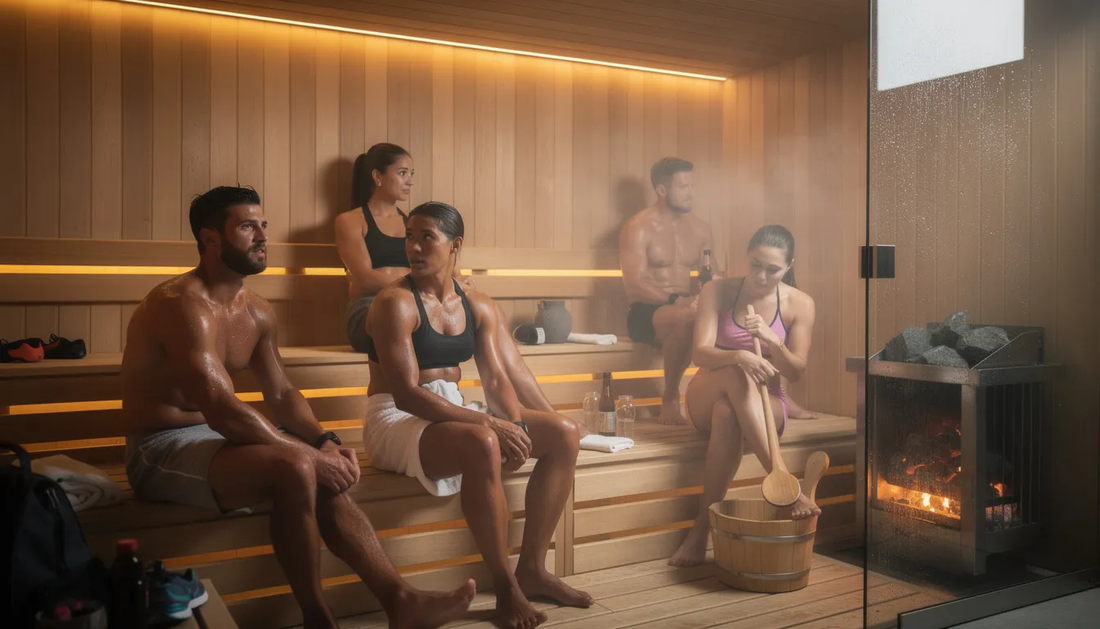
Athletes should use a sauna for structured heat adaptation 2–6 weeks before a competition to boost plasma volume by 7.1% and improve time to exhaustion by 32%. Within 48 hours of an event, shift to short, moderate sessions ($8$–$15$ minutes) to maintain gains without risking dehydration or fatigue.
When Should Athletes Use a Sauna Before Competition?
Editorial note: This article was written by Sun Home Saunas. It describes how athletes commonly schedule sauna and heat exposure around training and competition, and it reports what heat-acclimation research does and does not show. It is general educational information, not medical or performance-coaching advice, and it is not a claim that a sauna will improve any individual's results. Heat stress carries real risks (dehydration, overheating); anyone with a cardiovascular condition, recent illness, or injury should talk to a qualified physician before starting a heat protocol.
Direct answer: For most athletes, the sauna belongs in the training block, not the final hours before an event. Heat acclimation — repeated heat exposure spread across days and weeks — is the practice endurance athletes use to prepare the body for exercising in hot conditions, and it is best built 2–6 weeks out and then tapered as competition approaches. In the last 24–48 hours, long or very hot sessions are generally avoided, because the fluid loss and thermal load can leave you dehydrated and flat on race day. Any protocol should be tested during training and paired with careful hydration — never introduced for the first time at a key event.
Key Takeaway
- Build heat acclimation with structured sessions 2–6 weeks before a key event, then taper — not in the final days.
- Avoid long or very hot sauna sessions within 24 hours of competition; if you use the sauna at all in race week, keep it short and comfortable.
- Hydration, electrolyte balance, and testing your timing during training blocks are essential — never experiment on competition day.
- Post-training, many athletes use gentle heat as part of a wind-down routine because they find it relaxing; treat that as a comfort/recovery habit, not a guaranteed physiological outcome.
- An at-home Sun Home Saunas infrared or traditional sauna makes it easier to control timing, duration, and temperature on your own schedule, without gym hours or crowded facilities.
Why Does Sauna Timing Matter Before Competition?
Direct answer: The same 20–30-minute session that helps build heat acclimation when done weeks out can work against you a few hours before a hot event, because it adds fluid loss, an elevated heart rate, and short-term fatigue on top of the demands of the race itself. Timing is what separates a useful training tool from a race-day liability.
Both traditional and infrared sauna sessions place a load on the cardiovascular system that is often compared to light exercise: the body responds to the heat by increasing circulation, raising core temperature, and producing sweat. Over weeks, repeated exposure is what drives the body to adapt. In the final hours before an event, that same load simply draws down resources you would rather bring to the start line.
Sensible timing accounts for several variables:
- Sport type: Endurance events and short, explosive events have different demands.
- Event duration and climate: A hot-weather marathon or triathlon is a different problem than a cool-weather 5K or an indoor meet.
- Heat-adaptation status: Athletes who have already done structured heat work have banked most of the adaptation and need very little, if anything, in race week.
- Individual response: People tolerate heat differently; the only reliable guide is your own logged experience in training.
This article focuses on practical timing you can plug into a real training and competition calendar, whether you use a compact at-home infrared sauna or a traditional setup.
How Should Athletes Use a Sauna in the 2–6 Weeks Before a Key Event?
Direct answer: This is the window where heat work belongs. Athletes typically run a block of sessions after easy training days for a couple of weeks, then reduce sauna volume as the event gets closer so that any adaptation is banked while race-day freshness is protected.
What frequency and session parameters do athletes commonly use?
- Frequency: Commonly 3–5 sessions per week for 2–4 weeks, then taper sauna volume as race day approaches.
- Traditional sauna: Roughly 15–30 minutes at conventional sauna temperatures.
- Infrared sauna: Roughly 20–35 minutes at a lower cabin temperature (many athletes use about 120–140°F).
Sessions are often scheduled immediately after easy runs or rides, to add a heat stimulus without piling on extra hard training. If you are new to heat work, build up gradually and shorten or skip a session if you feel run-down. Our beginner's guide to using a sauna covers how to ramp up safely.
What does heat-acclimation research show — and not show?
Heat acclimation is a well-established concept in sports science: repeated heat exposure over days to weeks is a recognized way to prepare the body for exercising in the heat. Studies of post-exercise sauna bathing in trained runners — for example, Scoon and colleagues (2007) and Kirby and colleagues (2021) — have examined markers such as plasma volume and endurance capacity after multi-week protocols.
The important limitations, stated plainly: most of this research uses traditional (dry) saunas, not infrared cabins; the studies are small; and results vary a lot between individuals. Findings from one modality, temperature, and population do not automatically transfer to a different setup or to any specific product, and none of these studies were conducted on Sun Home Saunas equipment. The honest takeaway is that heat acclimation is a real and widely used training practice, but the size of any benefit for a given athlete is uncertain and individual — treat it as one tool to test in training, not a guaranteed performance boost.
Timing caution: Do not begin an aggressive heat block in the last 7–10 days before an A-race. Adaptation needs time to settle, and pushing heat work too close to the event can leave you feeling flat.
An at-home Sun Home Saunas unit lets you control session temperature and duration day to day during this adaptation phase — something public facilities rarely allow.
What Is the Ideal Race Week Sauna Strategy in the Final 7 Days?
Direct answer: Race week is about maintaining what you have built while protecting freshness. The common mistake is carrying full training-block sauna volume into the taper and arriving depleted. Reduce either session length or frequency across the week.
What does a race-week protocol look like?
- 7 days out: Last full-length session (about 20–30 minutes), if you use one at all.
- 5–6 days out: One moderate session if desired.
- 3–4 days out: Lighter, shorter sessions (about 10–15 minutes) at lower temperatures.
- 1–2 days out: Minimal or no sauna exposure.
Athletes heading into hot-weather events sometimes keep one short, easy session about 36–48 hours before, mainly to stay familiar with the heat. Kept brief and gentle, that session is about comfort and readiness, not another hard adaptation stimulus.
How do you monitor your response during race week?
Log a few simple markers so you can catch warning signs early:
- Subjective fatigue (a 1–10 self-rating)
- Sleep quality and duration
- Morning resting heart rate
- Hydration status (urine color)
If any of these trend the wrong way — elevated resting heart rate, poor sleep, lingering tiredness — reduce or drop the remaining sauna sessions. A Sun Home Saunas infrared model can be set to a lower temperature for a short, easy race-week session when you want warmth without heavy sweating.
Should Athletes Use a Sauna the Day Before Competition?
Direct answer: The day before is where timing mistakes are most common and most costly. If you use the sauna at all, keep it short and comfortable — most athletes are better off doing very little or nothing.
What are sensible day-before guidelines?
- Session length: Only short, moderate sessions (roughly 8–15 minutes), if any.
- Temperature: Comfortable warmth, not maximal heat tolerance.
- Goal: Relaxation and light sweating — not pushing limits.
Avoid long (20–30+ minute) or very hot sessions within 24 hours of competition. The fluid loss can be hard to fully replace overnight, and heavy heat stress the day before adds fatigue you do not want to carry into the event. If you do a light session, schedule it at least 10–12 hours before the start — for a morning race, that means the late afternoon before, not the evening.
Are there sport-specific considerations for the day before?
Endurance athletes racing marathons, triathlons, or cycling events in the heat who are already heat-adapted often skip the sauna entirely the day before. As the triathlon coaching guidance summarized by Triathlete puts it, once the adaptation is banked there is little to gain from one more session and some risk in adding it. A very short, mid-afternoon session paired with easy mobility work is, at most, a way some athletes wind down — the value there is relaxation, not another training effect.
Should You Use a Sauna on Race Morning?
Direct answer: For most athletes, a full sauna session on race morning is not recommended. Even 10–15 minutes of real heat can cost fluid and add short-term fatigue, which matters most before endurance events longer than about 60 minutes.
When might a brief race-morning session make sense?
The narrow exception is a very brief, gentle warm-up in a moderate infrared environment — and only if you have tested it in training first:
- Duration: About 5–8 minutes maximum
- Temperature: Moderate warmth (many use roughly 110–120°F)
- Purpose: Loosening joints for indoor sports or cold-weather events
Used this way, the aim is simply to feel warm and ready without the fluid cost of a full session.
What are the ground rules for race-morning heat exposure?
- Test any race-morning approach several times in training — never for the first time at a key event.
- Follow any heat exposure with at least 60–90 minutes of a cool, calm pre-race routine.
- Hydrate deliberately, with electrolytes.
- Monitor how you feel during warm-up; if you feel sluggish, drop it next time.
A Sun Home Saunas at-home unit lets you trial this timing weeks earlier and see how your warm-up and early efforts feel, so nothing is a surprise on event day.
What Recovery Protocols Keep Pre-Competition Sauna Use Safe?
Direct answer: Around competition, hydration and sensible limits matter more than any single session. Heat that feels helpful in a training block becomes a liability when timing, hydration, or intensity are wrong in the final days.
Away from competition, many athletes use gentle heat after training as part of a wind-down routine and simply say it feels relaxing and helps them settle. That is a reasonable comfort-and-recovery habit — but it is a subjective experience, not a promise of a specific physiological result, and it is not a substitute for sleep, nutrition, and easy days.
What are the hydration and safety guidelines?
- Begin race week well-hydrated; don't rely on last-minute fluid loading.
- Use electrolytes before and after sauna sessions.
- Avoid alcohol in the 24 hours before both a sauna session and the race.
- Cool down fully after sessions — don't stack heat stress.
Our overview of saunas and hydration goes deeper on staying safe during heat therapy.
What warning signs mean you should stop?
Stop sauna use and prioritize rest if you experience any of the following:
- Dizziness or lightheadedness
- Heart palpitations or an irregular heartbeat
- Sleep disruption after sessions
- Fatigue that doesn't resolve with rest
- A headache that persists after rehydration
- Unusually dark urine despite adequate fluids
Athletes with cardiovascular conditions, recent illness, or acute injuries should consult a sports physician before starting any heat protocol. The American College of Sports Medicine publishes evidence-based guidance on exertional heat illness in training and competition that is worth reviewing. Individual conditions vary, and a self-experiment in race week is not the time to find your limits.
Sun Home Saunas designs emphasize low-EMF systems (independently tested by Vitatech Electromagnetics, which reported roughly 0.3–0.9 mG at a typical 3-foot seated distance), comfortable seating, and precise temperature control — all of which make a repeatable, well-controlled routine easier to build.
Pre-competition sauna timeline: a quick reference
The table summarizes a conservative approach at each stage. Use it as a starting point and adjust based on your own logged response.
| Time before event | Typical session | Main goal | After the session | When to skip |
|---|---|---|---|---|
| 2–6 weeks out | 20–30 min (traditional) or 25–35 min at a lower temp (infrared) | Build heat acclimation | Water + electrolytes, cool down, light stretching, good sleep | If recovering from illness, after a hard interval day, or if you feel run-down |
| 7–4 days out | 15–20 min at moderate temperatures | Maintain adaptation while reducing load | Hydration focus, early bedtime, watch morning resting heart rate | After long-haul travel, if sleep has declined, or if fatigued |
| 3–2 days out | 10–15 min at comfortable warmth, or skip | Light maintenance, relaxation | Gentle hydration, prioritize sleep, avoid alcohol | If any warning signs are present, after a hard workout, or if already flat |
| Day before | 8–15 min at low-moderate heat, at least 10–12 hours before start | Relaxation, pre-race calm | Water + electrolytes, cool down completely, early bedtime | Avoid long or evening sessions, sauna after alcohol, or if dehydrated |
| Race morning | 5–8 min at moderate warmth (infrared) only if tested before, or skip | Joint mobility for cold conditions (optional) | 60–90 min cool pre-race routine, deliberate hydration | Before endurance events over ~60 min, if untested, before hot-weather races, or if unwell |
How Do Infrared and Traditional Saunas Compare for Pre-Competition Use?
Direct answer: The two modalities stress the body differently, which affects how you schedule them. A fuller comparison is in our guide to infrared vs. traditional saunas; the short version for athletes is below.
What makes traditional saunas different?
Traditional saunas heat the air around you to higher temperatures, which produces faster, more intense sweating and a heart-rate response many people compare to moderate exercise. That makes them a strong heat-acclimation tool in a training block, but it also means sessions may need to be shorter and scheduled further from race day to allow full recovery.
What are the practical advantages of infrared for athletes?
Infrared saunas run at lower cabin temperatures (commonly around 120–150°F), which many athletes find allows a more comfortable, controllable session. For race week specifically, the ability to dial in a lower temperature — warm enough to keep a routine, gentle enough to avoid fatigue — is convenient. This is a comfort-and-control advantage, not a claim that one modality delivers a superior medical outcome.
How do you choose a protocol?
Standardize on a single modality (infrared or traditional) within a training block so your response is easier to interpret; switching mid-cycle muddies the picture. The biggest practical edge of an at-home Sun Home Saunas unit over a crowded public sauna is control — you own the timing, temperature, and duration from start to finish, which is exactly what a pre-competition routine needs.
How Do You Build a Personalized Pre-Competition Sauna Routine?
Direct answer: Treat sauna timing like any other trainable variable — test it, log it, and adjust. What works for a marathoner may not suit a strength athlete or a cyclist prepping for a hot stage race.
A step-by-step approach
- Choose your equipment: Pick a Sun Home Saunas model that fits your space and calendar — an infrared cabin for regular indoor use, an outdoor unit for larger sessions, or a portable option for travel.
- Pick a target event: Choose a competition 8–12 weeks out to use as a test case.
- Run a test block: Add a 2–3-week sauna protocol during base training.
- Track everything: Log session duration, temperature, time of day, and how you feel in the following workouts.
- Adjust based on data: Modify frequency, timing, and intensity based on what your own log shows.
How does adding cold fit in?
Some athletes finish certain training-block sessions with a cool shower or a cold plunge as part of a contrast routine, and generally report it feels refreshing. Two practical cautions: keep contrast work in training rather than the final days before an event, and avoid heavy cold exposure right before hot-weather races, since it can work against the heat familiarity you have built. Separate any structured contrast protocol from competition by a comfortable margin, and — as with everything here — test it in training first.
Your home as a controlled setting
The advantage of an at-home setup is repeatability: you can hold temperature, duration, and time of day steady and change one variable at a time. That consistency is hard to get at a public facility, and it is what lets you learn what your body actually needs at each point in a training cycle.
Master Pre-Competition Sauna Timing
Used well, the sauna is a training-block tool, not a race-morning trick. Heat-acclimation work is best built weeks out and then tapered, so any adaptation is banked while you arrive fresh and well-hydrated.
The core skill is separating two very different jobs: training-phase heat work (which can be frequent and structured) from competition-week strategy (which should be light, conservative, and precisely timed). Get that distinction right, hydrate carefully, and test everything in training.
If you want a setup that makes controlled, repeatable sessions easy, Sun Home Saunas builds at-home infrared and traditional saunas designed for exactly that kind of consistency. Reach out to our sauna experts for help choosing a model that fits your training environment and event calendar.
FAQs
How many days before a marathon should I stop full sauna sessions?
Many marathoners end full-length (20–30 minute) high-heat sessions about 4–6 days before race day, keeping only 1–2 shorter, easier sessions up to about 2–3 days out if they feel fresh and well-hydrated. The aim is to reach the start line with stable hydration and no lingering heat fatigue. Test any approach in earlier training blocks — ideally before a tune-up race — rather than introducing it before a key marathon.
Is sauna use worthwhile before short, explosive events like sprints or weightlifting?
For short, maximal-power events, heavy or fatiguing heat sessions close to the event are generally counterproductive, because the short-term fatigue from heat exposure can reduce force production when you need it most. Some athletes use brief, gentle warmth on training days for comfort and mobility, but keep it well away from meets requiring maximal power, and always test it in training first.
Can I combine a cold plunge with pre-competition sauna sessions?
Contrast work — a sauna session followed by a cold plunge — is something many athletes use during training blocks and find refreshing. Using cold right after every hot session may work against the heat familiarity you are trying to build, so lean on contrast more during heavy training weeks and scale it back in the final days before hot races. Extreme cold immediately before an event can also temporarily lower muscle temperature and power output, so test any protocol in training before applying it to race week.
What are the signs I'm overdoing sauna use before a race?
Watch for an elevated resting heart rate (several beats above your normal), persistent fatigue that doesn't improve with rest, poor sleep or trouble falling asleep, dizziness when you stand quickly, and unusually dark urine despite drinking enough. If these show up in race week, cut back or stop sauna sessions, focus on fluids and electrolytes, and prioritize rest. If symptoms persist, consult a sports physician — what feels like overtraining can sometimes be dehydration or another issue that needs attention.
Do elite athletes actually use a sauna for pre-competition heat preparation?
Yes — many endurance athletes use structured heat blocks (saunas, hot baths, or hot-weather training camps) in the weeks before major hot races, and published research on post-exercise sauna bathing has looked at markers like plasma volume and heat tolerance. What sets careful use apart is timing, monitoring, and individualization — which can be replicated at home with a consistent routine and honest tracking, without expecting a fixed, guaranteed result.
References
- Kirby NV, et al. "Intermittent Post-Exercise Sauna Bathing Improves Markers of Exercise Capacity in Hot and Temperate Conditions in Trained Middle-Distance Runners." (Traditional sauna; trained runners; small sample.) PMC7862510
- Scoon GSM, et al. "Effect of Post-Exercise Sauna Bathing on the Endurance Performance of Competitive Male Runners." (Traditional sauna; small sample of competitive male runners.)
- American College of Sports Medicine Position Stand — "Exertional Heat Illness During Training and Competition." PubMed 17473783
- Harvard Health Publishing — "Saunas and your health." health.harvard.edu
- Triathlete — "The Right (and Very Wrong) Way to Sauna Train for Triathlon." triathlete.com
Note on the research: the studies above largely used traditional (dry) saunas with small numbers of trained endurance athletes. They describe a general training practice; they do not measure any specific product, and results vary between individuals.

